SFM to RPM Calculator: Cutting Speeds for Drill Presses, Metal Bandsaws and Cold Saws
Pick your machine, the material and the bit or blade size and get the RPM or blade speed to set, with SFM charts for drilling, bandsaws, cold saws and belt grinders and the speed ranges of the machines we carry.
Key takeaways
- Cutting speed is set in SFM, surface feet per minute, and depends on the material and the tool, not the machine.
- RPM = SFM x 3.82 divided by the diameter in inches. SFM = RPM x diameter x 0.262.
- A 1/2 inch HSS drill in mild steel runs about 610 to 840 RPM; stainless needs about a third of that.
- Bandsaw blade speed is already in feet per minute, so you set the SFM directly: about 150 to 230 for mild steel with a bimetal blade.
- Large holes and stainless need a machine with a low bottom speed, so check the speed range before you buy.
Every metal cutting machine in a shop has one speed that cuts clean and lasts, and a lot of speeds that burn bits, strip teeth or just rub. That right speed is not an RPM. It is a surface speed, measured in surface feet per minute (SFM), and it depends on the material and the tool more than on the machine. Once you know the SFM, turning it into the RPM for your drill press or cold saw is one line of math.
Pick your machine, the material and the bit or blade size, and the calculator below gives you the RPM or blade speed to set, plus which drill presses, metal bandsaws and cold saws we carry can actually run at that speed. Under it you will find the formula, cutting speed charts for each machine and the speed ranges of the Dake and Laguna machines in our catalog.
SFM to RPM cutting speed calculator
Pick the machine, the material and the bit or blade size. Results update as you type.
Set about 610 to 840 RPM
80 to 110 SFM x 3.82 / 0.5 in
Machines we carry that run at this speed
- Dake TB-16 5/8" Bench Drill Press, 9 Speed, 110V
- Dake TB-16V 5/8" Variable Speed Bench Drill Press, 110V
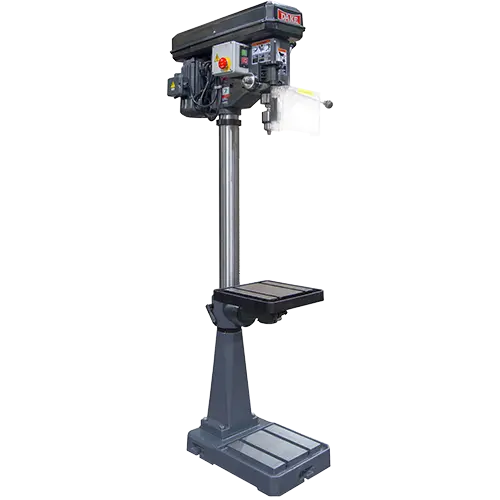
- Dake SB-16 5/8" Floor Drill Press, 9 Speed, 110V
- Dake SB-25 1" Floor Drill Press, 9 Speed
- Dake SB-25V 1" Variable Speed Floor Drill Press, 110V
- Dake SB-32V 1-1/4" Variable Speed Floor Drill Press, 110V
- Dake SB-250V 1" Auto Feed Variable Speed Floor Drill Press, 110V
- Laguna DP-20 1.5 HP Touchscreen Variable Speed Drill Press, 110V
- Laguna DX-20 2.5 HP Touchscreen Variable Speed Drill Press, 220V
- Laguna B:5 5" Benchtop Variable Speed Metal Bandsaw, 120V
- Laguna B:7X 7" Horizontal Metal Bandsaw with Stand and Coolant, 120V
- Dake SE712 7" x 12" Horizontal Metal Bandsaw, 110V
- Dake SE912 9" x 12" Horizontal Metal Bandsaw, 110V
- Dake SE-6.5 M 6.5" Mitering Horizontal Bandsaw, 120V
- Dake SE-810 Dual Mitering Horizontal Bandsaw, 110V
- Dake SE-10 DM 10" Dual Mitering Horizontal Metal Bandsaw, 220V 3 Phase
- Dake SE1018 10" x 18" Horizontal Metal Bandsaw, 220V
- Dake VDL-18 18" Multi-Purpose Vertical Bandsaw for Metal and Wood, 110V
- Dake V-16 15-1/2" Throat Vertical Metal Bandsaw, 220V 3 Phase
- Dake V-26 26" Throat Vertical Metal Bandsaw with Manual Feed Table, 220V 3 Phase
- Dake V-26E 26" Throat Vertical Metal Bandsaw with Power Feed Table, 220V 3 Phase
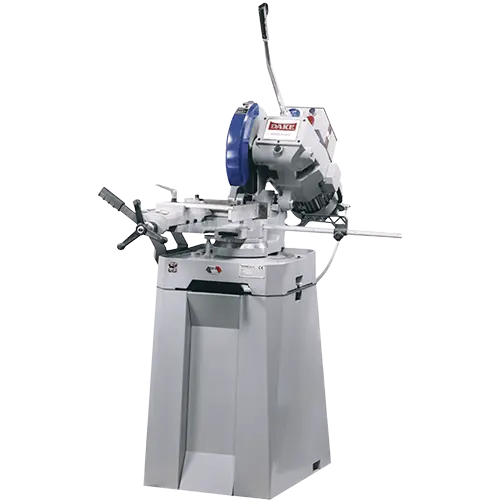
- Dake Technics 250 10" Manual Cold Saw, 110V
- Dake Super Cut 315 12-1/2" Manual Cold Saw
- Dake 350CE 14" Manual Cold Saw, 220V 3 Phase
- Dake 350SA 14" Semi-Automatic Cold Saw, 220V 3 Phase
- Dake Euromatic 370S 14-1/2" Semi-Automatic Ferrous Cold Saw, 220V 3 Phase
- Dake Euromatic 370PP 14-1/2" Automatic Ferrous Cold Saw, 220V 3 Phase
- Dake Euromatic 370S-L 14-1/2" Semi-Automatic Non-Ferrous Cold Saw, 220V 3 Phase
- Dake Euromatic 370PP-L 14-1/2" Automatic Non-Ferrous Cold Saw, 220V 3 Phase
Send us your materials and we will match the machine
Starting ranges for planning. Begin at the low end, watch the chips, and follow the speed chart of your bit or blade maker when it differs.
How to set the right cutting speed in 5 steps
- Name the material and the cutting tool. Mild steel with a high speed steel (HSS) drill, stainless with a cobalt drill, aluminum with a carbide tipped saw blade. The pair decides the speed.
- Look up the SFM range for that pair. Use the charts below or the chart from your bit or blade maker.
- Measure the diameter that does the cutting. That is the bit diameter on a drill press, the blade diameter on a cold saw and the drive wheel diameter on a belt grinder. A bandsaw blade speed is already a surface speed, so there is nothing to convert.
- Convert SFM to RPM. RPM = SFM x 3.82 divided by the diameter in inches.
- Set the nearest machine speed at or just below the answer, then listen and look at the chips. Blue chips, smoke or squeal mean too fast. Dust instead of chips, or a bit that rubs, means too slow or too little feed.
What SFM means
SFM, also written SFPM, stands for surface feet per minute. It is how many feet of cutting edge pass over the work in one minute. A 1 inch drill at 400 RPM and a 1/4 inch drill at 1,600 RPM have the same cutting edge speed at their outer corners, about 105 SFM, even though one spins four times faster.
That is why speed charts from tool makers list SFM instead of RPM. The right surface speed for a material barely changes with bit size, so one SFM number covers every diameter. You only convert it to RPM at the machine. Metric charts use meters per minute (m/min). One SFM equals 0.3048 m/min.
The SFM to RPM formula
RPM = SFM x 12 divided by (3.1416 x diameter in inches), which shop people shorten to RPM = SFM x 3.82 divided by diameter.
SFM = RPM x 3.1416 x diameter in inches divided by 12, or SFM = RPM x diameter x 0.262.
In metric: RPM = m/min x 1,000 divided by (3.1416 x diameter in mm).
Example: a 1/2 inch HSS drill in mild steel at 100 SFM. 100 x 3.82 divided by 0.5 is 764, so set the drill press to about 760 RPM, or the nearest step below it. The same bit in aluminum at 250 SFM runs about 1,900 RPM, and in stainless at 40 SFM about 300 RPM.
The calculator rounds RPM to the nearest 10 above 100 RPM and to the nearest whole number below that, because no machine dial is finer than that and the SFM charts are ranges anyway.
Drilling speed chart in SFM by material
These are starting ranges for jobber length twist drills with cutting fluid. Use the low end for deep holes, large bits, worn bits or dry cutting, and the high end for shallow holes and sharp bits. Cobalt (M35 or M42) drills run about 10 percent faster and hold their edge much better in stainless and hard steel.
| Material | HSS drill, SFM | Cobalt drill, SFM | 1/2 inch HSS drill, RPM |
|---|---|---|---|
| Aluminum | 200 to 300 | 220 to 330 | 1,530 to 2,290 |
| Brass and bronze | 150 to 250 | 165 to 275 | 1,150 to 1,910 |
| Mild steel (1018, A36) | 80 to 110 | 88 to 121 | 610 to 840 |
| Cast iron (gray) | 60 to 80 | 66 to 88 | 460 to 610 |
| Alloy steel (4140, annealed) | 50 to 70 | 55 to 77 | 380 to 530 |
| Tool steel (annealed) | 40 to 60 | 44 to 66 | 310 to 460 |
| Stainless steel (304, 316) | 30 to 50 | 33 to 55 | 230 to 380 |
For the full RPM chart by bit size, from 1/8 inch to 1 inch, see our drill press speed chart for metal. It uses the middle of each range above.
Metal bandsaw blade speed chart
A bandsaw blade moves in a straight line, so its speed is already a surface speed. Saw makers print it in feet per minute (FPM or SFPM), and it means the same thing as SFM. There is no RPM to work out; you pick the speed step or turn the dial to the number.
The ranges below are for bimetal blades on solid stock 1 to 3 inches across. Thin wall tube, angle and stock under 1 inch can run about 15 percent faster. Solid stock over 3 inches should run about 20 percent slower. The calculator applies both adjustments.
| Material | Bimetal blade, ft/min (SFM) | Notes |
|---|---|---|
| Aluminum | 250 to 400 | Many horizontal saws top out near 260 to 330, which still cuts fine with a coarse blade |
| Brass and bronze | 150 to 250 | Use a sharp blade; dull teeth rub and glaze |
| Mild steel (1018, A36) | 150 to 230 | The everyday setting on most horizontal saws |
| Cast iron (gray) | 100 to 150 | Usually cut dry |
| Alloy steel (4140) | 110 to 170 | Coolant helps blade life a lot |
| Tool steel (annealed) | 70 to 120 | Slow and steady feed |
| Stainless steel (304, 316) | 60 to 100 | Never let the blade rub; keep a steady feed so it does not work harden |
Speed is only half of the setup. Tooth pitch matters as much, and you want at least three teeth in the cut. Our bandsaw blade TPI guide covers that, and horizontal vs vertical bandsaw explains which saw style fits your work.
Cold saw speed chart
A cold saw runs a large toothed circular blade slowly, so the teeth take a real chip and the cut stays cool and burr free. Because the blade is big, the RPM is low: a 14 inch blade at 41 RPM is already moving about 150 SFM at the teeth.
| Material | Blade | SFM, solid stock | 14 inch blade, RPM |
|---|---|---|---|
| Mild steel | HSS | 100 to 150 | 27 to 41 |
| Alloy steel | HSS | 70 to 110 | 19 to 30 |
| Cast iron | HSS | 70 to 110 | 19 to 30 |
| Tool steel | HSS | 50 to 80 | 14 to 22 |
| Stainless steel | HSS | 45 to 75 | 12 to 20 |
| Brass and bronze | HSS | 200 to 400 | 55 to 110 |
| Aluminum | Carbide tipped, non ferrous saw | 6,000 to 12,000 | 1,640 to 3,270 |
Tube, angle and other thin wall sections can run about 30 percent faster than solid bar with an HSS blade. Aluminum is the big exception on a cold saw. It needs a non ferrous saw that spins in the thousands of RPM with a carbide tipped blade; a ferrous cold saw at under 100 RPM will load and smear the teeth. If you are torn between saw types, read cold saw vs band saw.
Belt grinder belt speed
Belt speed works the same way as a cold saw: belt SFM = motor RPM x drive wheel diameter in inches x 0.262. A 4 inch drive wheel on a 3,450 RPM motor moves the belt at about 3,610 SFM. Use the converter mode of the calculator with the wheel diameter to check any grinder.
Most metal grinding with ceramic or zirconia belts works well between about 4,000 and 6,000 SFM. Slow down for finishing, for heat sensitive parts like knife edges and hardened tools, and for stainless, which heats fast. A variable speed grinder lets you do both on one machine. The Dake BG-60V runs 800 to 8,000 SFM, while the Dake FG-75 runs a fixed 6,000 SFM and the SG-75 a fixed 5,018 SFM. Our belt grinder buying guide compares them.
Speed ranges of the machines we carry
These come from the spec sheets on each product page. The calculator checks your answer against the same numbers and only lists a machine when it can run within about 10 percent of the recommended range.
| Machine | Speed | Capacity |
|---|---|---|
| Dake TB-16 bench drill press | 240 to 3,400 RPM, 9 speeds | 5/8 inch |
| Dake TB-16V bench drill press | 545 to 4,000 RPM, variable | 5/8 inch |
| Dake SB-16 floor drill press | 240 to 3,400 RPM, 9 speeds | 5/8 inch |
| Dake SB-25 floor drill press | 270 to 2,000 RPM, 9 speeds | 1 inch |
| Dake SB-25V floor drill press | 46 to 3,550 RPM, variable | 1 inch |
| Dake SB-32V floor drill press | 46 to 3,473 RPM, variable | 1 1/4 inch |
| Dake SB-250V auto feed drill press | 68 to 1,380 RPM, variable | 1 inch |
| Laguna DP-20 and DX-20 drill presses | 60 to 3,600 RPM, variable | 5/8 inch chuck |
| Laguna B:5 benchtop metal bandsaw | 82 to 262 ft/min | 5 inch |
| Laguna B:7X horizontal bandsaw | 98 to 262 ft/min | 7 inch |
| Dake SE712 horizontal bandsaw | 85, 130, 180 and 235 ft/min | 7 inch rounds |
| Dake SE912 horizontal bandsaw | 98, 164, 246 and 328 ft/min | 9 inch rounds |
| Dake SE-6.5 M mitering bandsaw | 114 to 262 ft/min | 6.5 inch |
| Dake SE-810 dual mitering bandsaw | 65 to 250 ft/min | 8 inch |
| Dake SE-10 DM dual mitering bandsaw | 115 to 230 ft/min | 10 inch |
| Dake SE1018 horizontal bandsaw | 65 to 260 ft/min, variable | 10 inch rounds, 18 inch flats |
| Dake VDL-18 vertical bandsaw | 100 to 290 ft/min for metal, 1,200 to 3,500 for wood | 18 inch throat |
| Dake V-16 vertical bandsaw | 82 to 3,950 ft/min | 15 1/2 inch throat |
| Dake V-26 and V-26E vertical bandsaws | 50 to 415 and 550 to 5,000 ft/min | 26 inch throat |
| Dake Technics 250 cold saw | 44 RPM | 10 inch blade |
| Dake Super Cut 315 cold saw | 44 RPM | 12 1/2 inch blade |
| Dake 350CE cold saw | 22 to 88 RPM, variable | 14 inch blade |
| Dake 350SA semi automatic cold saw | 20 to 105 RPM, variable | 14 inch blade |
| Dake Euromatic 370S and 370PP (ferrous) | 25 and 50 RPM | 14 1/2 inch blade |
| Dake Euromatic 370S-L and 370PP-L (non ferrous) | 1,500 and 3,000 RPM | 14 1/2 inch blade |
Browse them all in drill presses, horizontal metal bandsaws, vertical metal bandsaws, cold saws and belt grinders.
Why the speed range of a machine matters more than its top speed
Most drill presses sold for wood start around 500 RPM. That is fine for small bits, but a 1 inch hole in mild steel wants about 310 to 420 RPM, and the same hole in stainless wants about 110 to 190 RPM. Run it at 500 and the bit corners burn and the stainless work hardens. If you drill large holes in steel, look for a low bottom speed: the Dake SB-25V and SB-32V go down to 46 RPM, and the SB-25 to 270 RPM.
The same thing applies to saws. A horizontal bandsaw with a lowest step of 98 or 114 ft/min will cut stainless, but slower blades last much longer in it. Saws that reach 65 or 85 ft/min, like the Dake SE-810, SE1018 and SE712, handle a mixed shop better. For a cold saw, a variable speed model like the 350CE or 350SA covers mild steel, stainless and brass on one blade size, while the fixed 44 RPM saws are built around mild steel and structural shapes.
Before you cut
- Start at the low end of the range and speed up only if the chips and the finish say you can.
- Feed matters as much as speed. A bit or blade that rubs without cutting dulls faster than one running a little too fast.
- Use cutting fluid for drilling and coolant for sawing steel and stainless. Cast iron and brass are usually cut dry.
- Clamp the work. Never hold metal by hand on a drill press, and use the vise on every saw.
- Check the label of your bit or blade. If its maker lists a different SFM, trust the maker.
Want to go further? Read the drill press buying guide, how to use a drill press, the bandsaw blade TPI guide and what is an ironworker. If you are setting up a metal shop and want help matching machines to the materials you cut, send us your list and we will suggest a drill press, saw and grinder that fit.
Frequently asked questions
What is SFM in machining?
How do you convert SFM to RPM?
What RPM should I use to drill steel?
What speed should a metal bandsaw run for steel?
What is the best cold saw speed for mild steel?
Why does aluminum need a faster cutting speed than steel?
How fast should a belt grinder run for metal?
Can one drill press handle both small and large holes in steel?
Recommended equipment