Belt Grinder Buying Guide: Belt Size, Speed and Power for Metal Shops
How to choose a belt grinder for metal work: belt sizes, fixed vs variable speed, contact wheels, power and footprint, plus a side by side look at the Dake FG-75, SG-75 and BG-60V.

Key takeaways
- Belt size sets what you can grind and how easy belts are to buy.
- Variable speed lets you slow down for heat sensitive work and finishing.
- Contact wheel size changes the grind: small wheels cut tight radii, large wheels make flatter, hollow grinds.
- Match the motor to your power: 110V single phase, 220V single phase or 220V three phase.
- The Dake BG-60V runs 800 to 8,000 ft/min on 110V.
A belt grinder removes stock, deburrs, shapes and finishes metal faster than a bench grinder, with less heat in the part and a flatter, more controllable surface. Fabrication shops use them for deburring and weld cleanup, maintenance shops for tool dressing and repairs, and makers for knife making and custom parts. This guide explains the features that matter and compares the three Dake belt grinders Forgeline carries.
What is a belt grinder used for?
- Deburring and chamfering cut parts.
- Grinding welds flush and cleaning up fabrications.
- Shaping and profiling small parts and tools.
- Sharpening and dressing chisels, punches and blades.
- Knife making: profiling, beveling and finishing.
- Finishing surfaces with progressively finer grits.
Belt size
Belt size is the first spec to check. Wider belts remove material faster and are steadier on flat work, while longer belts run cooler because each section of abrasive spends more time off the work. A 3 inch by 79 inch belt is a common industrial size. A 1.5 inch by 60 inch belt suits smaller benches and detail work. Pick a size you can buy easily in the grits you use.
Belt speed and variable speed
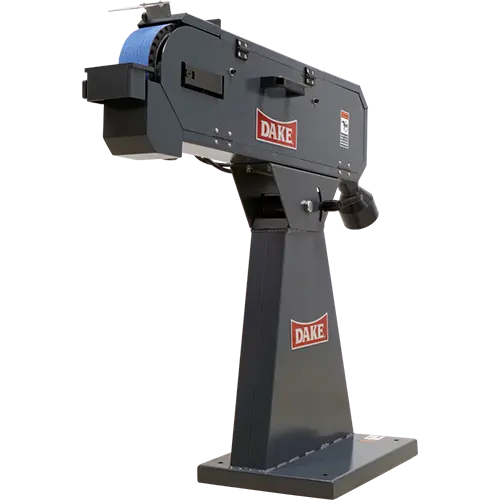
Higher belt speed cuts faster but builds heat. Lower speeds give more control for finishing, heat sensitive steels and careful edge work. A variable speed grinder lets you match speed to the job. The Dake BG-60V variable speed belt grinder uses an inverter drive for 800 to 8,000 ft/min, while the Dake FG-75 3x79 belt grinder runs at 6,000 ft/min and the Dake SG-75 standing belt grinder at 5,018 ft/min according to Dake.
Contact wheel size
The contact wheel is the wheel behind the belt where most grinding happens. Smaller wheels cut tight inside radii, and larger wheels make flatter or shallower hollow grinds. Dake lists a 3 inch by 8 inch contact wheel on the FG-75, a 4 inch wheel on the SG-75 and a 7 inch diameter wheel on the BG-60V.
Power and footprint
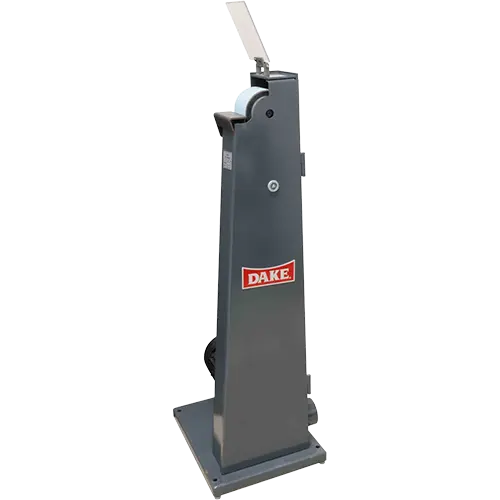
Check the motor against your shop power before you order. Dake lists the FG-75 at 4 HP, 220V three phase, and the BG-60V at 1.5 HP on 110V single phase. The SG-75 is a compact tower model; Dake lists it at 1.5 HP on 220V single phase. Weigh up floor space too: a standing grinder saves bench space, while a bench model can sit on an existing workbench.
Dake belt grinder comparison
| Dake FG-75 | Dake SG-75 | Dake BG-60V | |
|---|---|---|---|
| Belt size | 3 x 79 in. | 3 x 79 in. | 1.5 x 60 in. |
| Belt speed | 6,000 ft/min | 5,018 ft/min | 800 to 8,000 ft/min |
| Contact wheel | 3 x 8 in. | 4 in. | 7 in. diameter |
| Power (product page) | 4 HP, 220V 3 phase | 1.5 HP, 220V 1 phase | 1.5 HP, 110V 1 phase |
| Weight | 139 lb | 120 lb | 75 lb |
Specifications are from Dake product pages and may change without notice.
Which Dake belt grinder fits?
- Dake FG-75 3x79 belt grinder: the industrial choice for fabrication and job shops with three phase power. The head pivots for work height, and a hinged top cover opens to use the full belt length.
- Dake SG-75 standing belt grinder: a compact tower with quick belt changes and single knob tracking for shops short on bench space.
- Dake BG-60V variable speed belt grinder: a variable speed three wheel grinder on 110V, a good fit for knife making, detail work and shops without 220V.
Belt grinder safety
- Wear eye protection and keep guards and shields in place.
- Keep the work rest close to the belt.
- Never grind aluminum and steel in the same dust without cleaning; mixed dust can be a fire hazard.
- Hold small parts in a clamp or vise grip, not your fingers.
- Check belt tracking and tension before each session.
Belt grinder checklist
- Belt size and belt availability.
- Fixed or variable speed.
- Contact wheel size for your grinds.
- Motor and voltage that match your shop.
- Bench, tower or floor footprint.
- Guarding, work rest and dust management.
Products to consider
- Dake FG-75 3x79 belt grinder
- Dake SG-75 standing belt grinder
- Dake BG-60V variable speed belt grinder
Shop all belt grinders or every Dake machine.