Scissor Lift vs Alignment Lift: Which One Fits Your Bay
A comparison of scissor car lifts and alignment lifts, including mid rise versus full rise and where rolling jacks fit. Use the dedicated guides to choose a model.
Key takeaways
- A mid rise scissor car lift is for compact wheel and under body work. A full rise scissor lift adds published working height in a similar footprint.
- An alignment lift is a runway lift with slip plates and a plan for an alignment machine and a rolling jack.
- A rolling jack is an accessory for a compatible 4 post or alignment lift, not a stand alone lift.
- Confirm capacity, lift height, ceiling clearance, floor requirements, and power on the product page.
- Plan the wheel alignment machine and the rolling jack with the alignment lift so the stall is complete at install.
Scissor car lifts and alignment lifts solve two different shop problems, but buyers often shop them in the same session. A scissor car lift is a compact way to raise a vehicle for service in a bay that cannot accept a full 2 post or 4 post footprint. An alignment lift is a runway lift built so a wheel alignment can be measured and adjusted, usually with slip plates and a place for a rolling jack. This page is a comparison of the two tools: when a compact scissor lift is the better fit, when you need an alignment rack, and where rolling jacks belong in the same plan. For a mid rise versus full rise buying walkthrough, use our car scissor lift buying guide. For how to choose a 4 post alignment lift or alignment rack, use our alignment lift buying guide.
Browse the live scissor lifts and alignment lifts collections as you read, and confirm every capacity, height, and power number on the product page. For ceiling, concrete, and electrical site checks, use our guide to car lift ceiling height, concrete, and power requirements.
What a scissor car lift does well
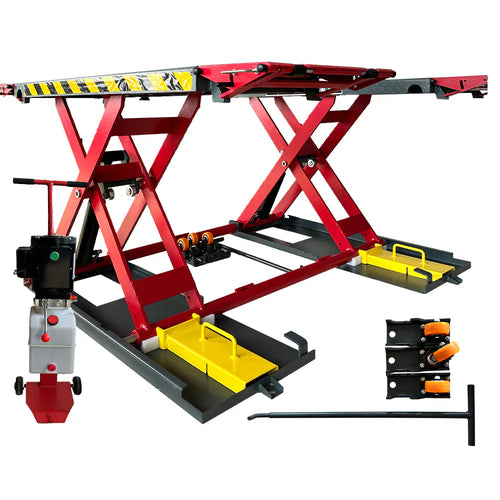
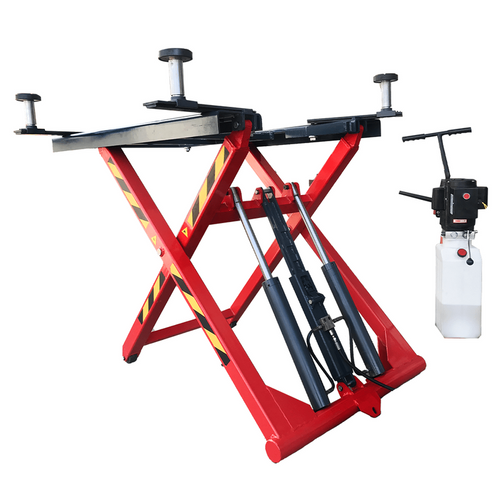
A scissor car lift uses linked arms in a scissor shape to raise a platform or a pair of runways. The design can be mid rise or full rise, stationary or portable, and it often uses a smaller floor footprint than a 2 post lift. That is why the term scissor car lift shows up in searches for home garages, mobile service, and compact shop bays.
Mid rise scissor lifts raise the vehicle to a working height that is useful for wheels, brakes, and many under body jobs, without taking the car to a standing technician height. Full rise or high rise scissor lifts raise the vehicle higher so you can stand more comfortably under the work. The published lift height is the number to compare, not the marketing name alone. A mid rise model and a full rise model can share a similar capacity and still feel very different in daily use.
Live examples in the catalog include the Katool KT X66 6,600 lb portable mid rise scissor lift, the Katool KT X77 7,700 lb mid rise scissor lift, and the Katool KT X99 7,700 lb full rise scissor lift with a published 76 in lift height. Those figures are published starting points. Your vehicle weight, lifting points, and bay height still have to match the exact model you buy.
Mid rise, full rise, and portable scissor lifts
Choose mid rise when the work is centered on wheels, brakes, body panels, and jobs that do not require a full standing height under the vehicle. Mid rise scissor lifts are also a common choice when ceiling height is limited, because the raised vehicle plus the lift structure still has to fit under lights, door tracks, or a low ceiling.
Choose full rise or high rise when technicians will spend long periods under the vehicle and you want more working height. Confirm both the published lift height and the overall height of the vehicle on the lift. A 76 in lift height is not the same thing as 76 in of clear standing room, because the vehicle body, running boards, or a lowered ride height will change the space you actually have.
Portable mid rise scissor lifts add another question: will you move the lift between stalls or job sites, or will it sit in one place most of the time? A portable design can free the floor when the lift is not in use, which is valuable in a shared garage. Moving a lift still requires the procedure in the manual, a floor that can support the load, and a plan for power or for a battery or pump system if one is specified. Do not treat portable as a reason to skip site requirements.
Some compact scissor tables exist for engines, components, or very light equipment rather than for a full passenger vehicle. Those tables belong in a different comparison. If you are shopping for a scissor car lift, filter by published vehicle capacity, not by the word scissor alone.
What makes an alignment lift different
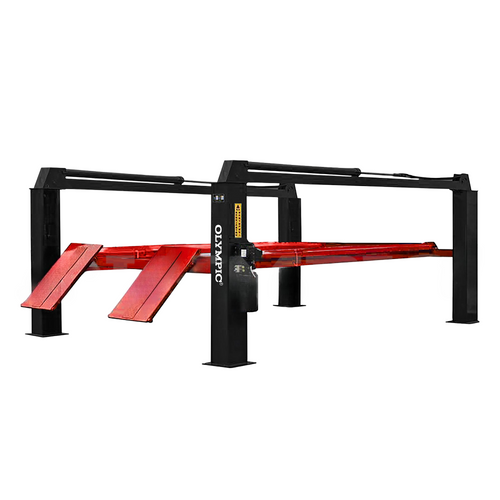
An alignment lift is usually a 4 post runway lift with features that let a wheel alignment machine measure the vehicle and let a technician adjust it. The common features are slip plates, a front area for turn plates or turntables, and a way to raise an axle with a rolling jack or a jacking beam. Without those features, a standard parking or service 4 post lift may hold the vehicle, but it is not set up as an alignment rack.
Slip plates allow the rear tires to move as the suspension settles and as the alignment is adjusted. Turn plates allow the front wheels to steer during measurements. A rolling jack raises an axle so you can remove a wheel or settle the suspension as the alignment process requires. The wheel alignment machine itself is a separate piece of equipment. Budget for the lift, the alignment machine, the turn plates if they are sold separately, and the rolling jack if it is not included. Our article on wheel alignment machine cost walks through those line items.
Live heavy alignment examples include the Olympic Big Rig 22,000 lb and 27,000 lb heavy duty alignment lifts. Lighter alignment lifts exist for passenger cars and light trucks. Match the published capacity and runway length to the vehicles you will align, including any fleet trucks, vans, or extended wheelbase models.
Alignment lift versus a standard 4 post lift
If you only need storage or general service, a standard 4 post car lift or a parking lift may be enough. If you plan to sell alignments or to align every vehicle you service, start in the alignment lifts collection and confirm that slip plates and the jacking plan are part of the package or are available as listed accessories.
Adding alignment features later is not always practical. A parking lift may not have the runway design, the plate recesses, or the jack rails that an alignment lift provides. If alignment is a planned service, it is usually simpler to buy the alignment lift first than to force a parking lift into that role.
If you are still deciding between 2 post and 4 post service layouts, use the 2 post versus 4 post car lift article alongside this guide. A 2 post lift is rarely the alignment rack. The alignment work almost always lives on a runway lift with plates. A 2 post lift can still be the right tool in the next stall for general service.
Rolling jacks and jacking beams
Rolling jacks, sometimes called rolling bridge jacks or jacking beams, travel on the rails or runways of a 4 post lift or an alignment lift. They raise one end of the vehicle, or both ends when used as a pair, so you can service wheels and brakes while the vehicle stays on the lift. They are a central accessory on an alignment lift and a useful add on for service work on a 4 post lift.
Capacity is the first specification to match. The rolling jack rating must fit the axle weight you will raise, and it must be listed as compatible with the lift you own or the lift you are buying. A jack that does not match the rail width or the lift model is not a bargain. See the lift accessories collection for jacks, adapters, and related parts, and confirm compatibility on the product page.
Rolling jacks are not a substitute for an alignment lift, and they are not a substitute for a mid rise scissor lift. They are a tool used with a runway lift. If your only goal is occasional wheel work in a home garage, a mid rise scissor lift or a quality floor jack and jack stands plan may be the simpler setup. If your goal is repeating brake jobs and alignments on a 4 post rack, a matched rolling jack should be in the original plan.
Site planning for both lift types
Scissor lifts and alignment lifts have different footprints, but they share the same site questions. What is the published capacity? What is the published lift height? What does the manufacturer require for concrete, anchors, and level? What power does the pump or the controls need? Where will the lowered lift sit, and can you still move vehicles through the bay?
A portable mid rise scissor lift may not need the same permanent anchors as a 4 post alignment lift, but it still needs a solid, level floor and a safe operating area. An alignment lift usually needs a dedicated stall with room for the alignment equipment, room to open doors, and a floor that meets the install sheet. Do not place either lift under a low obstruction that the raised vehicle will hit.
Think about the work flow around the lift. A scissor car lift often sits in a tight stall, so plan tool storage and jack stand placement before the lift arrives. An alignment stall needs space for the alignment machine, targets or cameras as the system requires, and a clear path to drive on and drive off the runways. Our broader car lift buying guide can help you place these lifts in a full shop layout next to other car lifts.
How to choose: a practical decision path
If you need compact vehicle access for wheel and brake work, and you may want to move the lift, shortlist portable mid rise scissor lifts in a capacity above your vehicle weight. If you need more working height in a compact footprint, shortlist full rise scissor car lifts and confirm the published lift height against your ceiling. If you will perform wheel alignments, shortlist alignment lifts and add the alignment machine, plates, and rolling jack to the same plan.
Do not use a mid rise scissor lift as a stand in for an alignment rack. Do not use an alignment lift as your only compact mid rise solution if you also need a portable lift for another stall. Many shops end up with both: a scissor car lift for quick wheel service and an alignment lift for the alignment stall.
Compare published specifications, not brand slogans. Katool and Olympic both have live scissor and alignment options in the collections linked above. Use the same checklist on every listing, including any other brand you evaluate:
- Rated capacity versus the actual vehicle weight you will lift
- Published lift height and overall height with your tallest vehicle
- Platform or runway style, and whether it matches the lifting points of your vehicles
- Power, air, and concrete or floor requirements
- For alignment lifts: slip plates, turn plate provision, and a compatible rolling jack
- For scissor lifts: mid rise or full rise, portable or stationary, and lowered height
Related equipment to plan at the same time
An alignment lift is only one part of an alignment stall. Plan the wheel alignment machine, the rolling jack, and any listed adapters together so you are not missing a required piece at install. A scissor car lift may also need adapters or rubber blocks specified by the manufacturer. Keep those items on the same order when they are required for the vehicles you service.
If parking and storage are still part of the same project, compare this guide with the parking lift options in parking lifts and with the 4 post options in 4 post car lifts. A parking lift, a scissor car lift, and an alignment lift can live in one shop, but they should be chosen for their own jobs rather than forced to cover every task.
The right choice is the lift whose published height, capacity, and accessories match the work you will do most often. Measure the bay, list the vehicles, and then shop scissor lifts or alignment lifts with those numbers in hand.
A side by side view of the four tools in this guide
It can help to put the four tools on one list before you open the catalog. A mid rise scissor car lift is for compact wheel and under body work at a moderate height, and it may be portable. A full rise scissor car lift is for the same compact footprint with more published lift height. An alignment lift is a runway lift with slip plates and a plan for an alignment machine and a rolling jack. A rolling jack is not a lift of its own. It is an accessory that works on a compatible 4 post or alignment lift.
If you try to make one of those tools do the job of another, the bay gets harder to run. A portable mid rise scissor lift will not give you an alignment stall. An alignment lift will not roll into a second garage the way a portable scissor lift can. A rolling jack will not create parking or alignment features that the host lift does not have. Choose the tool that matches the job you will sell or perform most often, then add a second tool if a second job is real and frequent.
Write one sentence for the stall you are building, such as compact wheel service, full rise service in a tight bay, or a dedicated alignment stall. Then open only the collection that matches that sentence first. You can always compare a second collection after the site measurements confirm that both lifts would fit.
Related buying guides
If storage is part of the same project, see the parking lifts buying guide. If you are also finishing the slab, see the garage floor tiles buying guide.
Weighing a two post lift as well? See our 2 post car lift buying guide.
Frequently asked questions
What is the difference between a mid rise and a full rise scissor car lift?
Do I need an alignment lift to do alignments?
Is a rolling jack included with an alignment lift?
Can a portable mid rise scissor lift replace an alignment lift?
What site checks matter for these lifts?
Do I also need a wheel alignment machine?
Recommended equipment