How to Use a Drill Press: Setup, Speeds and Safety for Metal and Wood
A step by step guide to using a drill press for metal and wood: choosing bits and speeds, setting depth, clamping, drilling, tapping and staying safe.

Key takeaways
- Always clamp the work or hold it in a drill press vise.
- Larger bits and harder metals need slower speeds.
- Use a center punch on metal and cutting fluid on steel.
- Set the depth stop before drilling blind holes.
- Remove the chuck key before starting and wear eye protection.
A drill press makes straight, repeatable holes that are hard to get with a hand drill. Learning how to use a drill press well comes down to four things: the right bit, the right speed, solid clamping and a steady feed.
Parts of a drill press
- Head and motor: drive the spindle through belts or a direct drive.
- Spindle and quill: the quill moves the spindle down when you turn the feed handles.
- Chuck: holds the drill bit.
- Table: supports the work and can often tilt and swivel.
- Depth stop: limits how far the quill travels.
How to use a drill press step by step
- Choose the bit. Twist bits for general work, step bits for sheet metal, Forstner bits for flat bottomed holes in wood.
- Install the bit and tighten the chuck. Remove the chuck key.
- Set the speed. Use the speed chart for your bit size and material.
- Mark and punch the hole. On metal, center punch so the bit does not wander.
- Clamp the work. Use clamps or a drill press vise. Put scrap wood under through holes.
- Set the depth stop for blind holes.
- Drill. Feed steadily, let the bit cut, and back out to clear chips on deep holes. Use cutting fluid on steel.
- Finish. Stop the spindle, clean chips with a brush, never by hand, and deburr the hole.
Drill press speed basics
The bigger the bit and the harder the material, the slower the speed. Small bits in wood and aluminum run fast; large bits in steel and stainless run slow. See our drill press speed chart for starting RPMs.
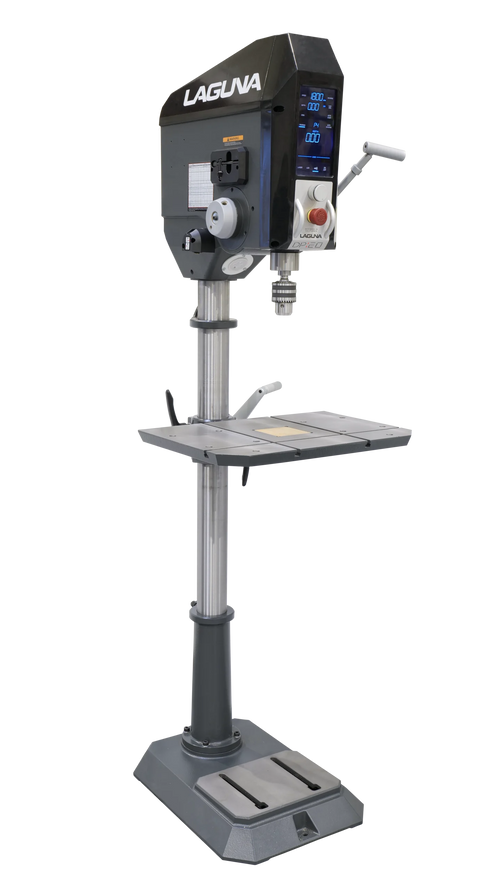
A variable speed drill press makes this easy. The Laguna DP-20 and Laguna DX-20 both list electronic variable speed from 60 to 3,600 rpm in forward and reverse, a 20 inch swing, 6 inches of quill travel and an LCD touchscreen with five speed and depth memories. The DP-20 has a 1.5 HP motor on 110-120V and the DX-20 a 2.5 HP motor on 220V. Both list auto start and auto reverse for tapping.
Tapping on a drill press
Drilling and tapping on the same setup keeps the tap square to the hole. On a press with reverse, drill the tap drill size, install the tap, run at low speed, and reverse to back the tap out. Use tapping fluid and follow the press manual.
Safety rules
- Wear eye protection and tie back hair and loose clothing. Do not wear gloves near the spinning bit.
- Clamp the work. A bit that grabs can spin unclamped parts.
- Remove the chuck key before starting.
- Use the right speed and do not force the feed.
- Stop the spindle before clearing chips or adjusting the work.
Common mistakes
- Running large bits too fast, which burns the bit and work hardens steel.
- Skipping the center punch on metal.
- Holding the part by hand.
- Drilling deep holes without backing out to clear chips.
Choosing bits by material
| Material | Bit type | Tips |
|---|---|---|
| Mild steel | HSS or cobalt twist bit | Center punch, cutting fluid, moderate speed |
| Stainless steel | Cobalt twist bit | Slow speed, steady pressure, plenty of fluid |
| Aluminum | HSS twist bit | Higher speed, clear chips often |
| Sheet metal | Step bit | Clamp to scrap wood to prevent spinning |
| Wood | Brad point or Forstner bit | Higher speed for small bits, slower for large Forstner bits |
| Plastic | Twist bit with a sharp edge | Moderate speed to avoid melting |
Drill press maintenance
- Clean chips from the table and column after each use.
- Check belt tension and condition on belt driven models.
- Lightly oil the column and table so they move freely and resist rust.
- Keep the chuck and arbor clean so bits run true.
- Check the table is square to the spindle before precision work.
Compare models in our drill press buying guide and shop drill presses.