Parking Lifts Buying Guide: 4 Post Garage Lifts and Car Storage Lifts
A parking first buying guide to 4 post garage lifts, car storage lifts, and when a 2 post lift can still work for garage parking.
Key takeaways
- Choose a parking lift by the daily routine first: drive on storage, frequent service, or a true mix of both.
- A 4 post garage lift is the common car storage lift because the vehicle sits on runways and the space below stays easier to use.
- Match published capacity, runway length, and vehicle height to every vehicle that might use the lift.
- Confirm ceiling height, concrete, and power from the manufacturer install sheet before you order.
- Use the existing 2 post versus 4 post article if you are still deciding between a service lift and a parking lift.
A parking lift is a car lift used first for storage, not for all day under car service. Shoppers looking for a 4 post garage lift, a car storage lift, or a car lift for a home garage are usually trying to park one vehicle above another, recover floor space, and still get a vehicle in and out without a full service bay setup. This buying guide focuses on that parking decision. For a side by side look at service style 2 post and 4 post lifts, start with our existing article on 2 post versus 4 post car lifts.
Use this guide to compare parking lifts, 4 post car lifts, and 2 post car lifts with a storage first checklist: capacity, runway or arm style, overall height, vehicle length, concrete, and power. Confirm every number on the product page and in the manufacturer install manual before you buy or schedule an install.
Parking lift versus service lift
A service lift is built so a technician can reach the vehicle often, move around the work, and use the lift as a daily tool. A parking lift is built so you can store a vehicle at height, park or work in the space below, and drive the stored vehicle down when you need it. Some lifts can do both, but the daily routine should drive the choice.
If you plan to change oil, inspect brakes, or do frequent under car work, a service oriented 2 post lift or a service 4 post lift may be the more practical tool. If your first goal is a car lift for the garage that adds a parking space, a 4 post parking lift or a dedicated car storage lift is usually the cleaner match. Many buyers end up wanting a little of both. In that case, be honest about which task will happen more often, because the lift style you choose will shape how easy each task feels.
A wider view of lift types is in our guide to choosing the right car lift. This article stays focused on parking and storage: how a 4 post garage lift uses runways, when a 2 post lift can store a vehicle, and when a multi level stacker is the better plan.
Why a 4 post garage lift is the common parking choice
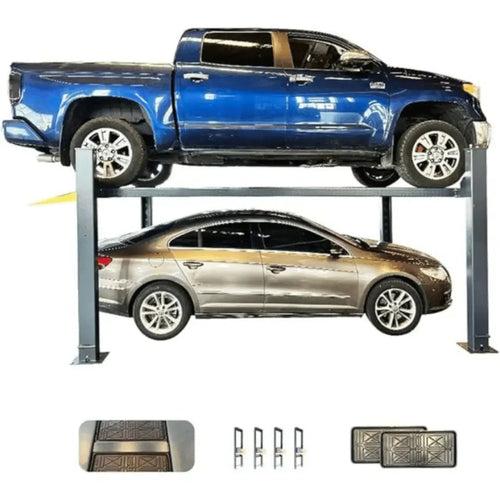
A 4 post parking lift uses two runways. You drive the vehicle onto the runways, set the parking brake, follow the chock and lock procedure in the manual, and raise the lift to the published height. The wheels stay on the runways, which is one reason this style is popular for daily parking and long term storage.
The space under the runways can hold a second vehicle, a work area, or storage, as long as the raised vehicle and the equipment below stay within the published capacity, width, and height limits. Because the vehicle sits on runways, opening doors, walking around the lower vehicle, and pulling a second car in are usually simpler than they are on a 2 post lift that holds the raised vehicle by the lifting points.
Live 4 post examples in the catalog include the Katool KT 4H850 at 8,500 lb and the Katool KT 4H110 at 11,000 lb, along with compact and multi level Olympic storage lifts. Those published capacities are a starting point only. Your vehicle, plus fuel, cargo, and any accessories, must stay under the rating on the exact model you buy.
When a 2 post lift can still work for parking
A 2 post car lift can store a vehicle, and it is often the first style people picture when they search for a car lift for a garage. The vehicle is lifted on arms and pads at the published lifting points. That leaves the underside open, which is excellent for service. For daily parking, it asks more of the operator. You have to place the arms correctly every time, confirm the pads, and be comfortable leaving the vehicle on those points for a longer period, following the manufacturer procedure.
A 2 post lift can also be the right parking tool when you need a narrower footprint, when you want a clear floor or a base plate design to match a low ceiling, or when service is still a large part of the plan. Clear floor 2 post lifts leave the floor open between the posts, which helps when you want to walk or roll equipment under a raised vehicle. Base plate 2 post lifts can fit under a lower ceiling because they do not use an overhead beam, but they place a plate at the floor and can change how you walk through the bay.
Live 2 post examples include the Olympic 2PCF 9 at 9,000 lb and the Katool KT M120 at 12,000 lb. If parking is the only job and you want the simplest daily drive on routine, compare those service lifts with the dedicated parking lifts collection before you decide.
Car storage lifts and multi level stackers
A car storage lift is a parking lift designed around stacking, not around a technician walking under a car all day. Some models store one vehicle over another on a single set of runways. Others, such as a triple stacker, create more than two parking levels so three vehicles can share one footprint. Live examples include the Olympic Triple Stacker S and the Olympic Triple Stacker XL three level storage lifts.
Stackers change the math for ceiling height, driveway approach, and daily use. You have to plan the height of each stored vehicle, the height of the lift structure, and the space needed to load the upper platforms. A low sports car on an upper platform can work in a room that will not accept a tall van in that same position. Measure the tallest vehicle you might store on each level, not only the vehicle you own today.
If you are comparing a standard 4 post garage lift to a multi level car storage lift, write down the number of vehicles you need to store, the height of each one, and how often you will swap their positions. A stacker is a space tool. A standard 4 post parking lift is often the simpler daily driver when you only need one vehicle above another.
Capacity, length, and width: the numbers that decide the model
Capacity is the first filter. Use a real weight, not a rounded guess. Check the owner documentation or a scale ticket for the vehicle you will store, then add passengers, fuel, cargo, a bed cap, a bumper, or a filled truck bed if those will be on the lift. Stay below the published rated capacity. If two vehicles will sit on the equipment in some stacker designs, confirm whether the published rating is per platform, per level, or for the complete structure.
Runway length and width come next on a 4 post parking lift or a storage lift. A long wheelbase truck, a van, or a vehicle with a long overhang needs runways that support the vehicle as the manufacturer describes, not just a capacity number. Measure wheelbase, overall length, and tire width. Compare those measurements with the published runway length, drive on width, and any notes about maximum vehicle length.
On a 2 post lift, the comparable measurements are lift height, arm reach, pad height range, and the published vehicle types the lift is designed to hold. Not every 2 post lift is a match for a unibody car, a lifted truck, or a vehicle with unusual lifting points. Confirm the arm style and pad adapters on the product page.
Width between posts or between runways also matters for the vehicle below. A lower vehicle with wide mirrors, a service cart, or a second set of doors needs a clear path. Walk the plan with a tape measure in the actual bay, including the swing of the garage door, the path to a house door, and the space needed to open the doors on the lower vehicle.
Ceiling height, floor, and power
A parking lift fails a site check more often on height and concrete than on color or brand. You need enough ceiling height for the lift structure, the raised vehicle, and any lighting or door tracks above the bay. You also need a finished floor height that accounts for the lower vehicle, the runway depth, and a safe margin. Measure from the slab to the lowest overhead obstruction, not to the peak of the ceiling.
Concrete thickness, strength, and anchor specifications are set by the lift manufacturer, not by a general rule of thumb. A slab that is too thin, too new, or poorly reinforced can prevent a safe install. Power needs also vary: some parking lifts use a standard shop circuit, and some need a dedicated circuit or a different voltage. Read the published electrical requirements and plan the circuit before the lift arrives.
These site checks are covered in detail in our guide to car lift ceiling height, concrete, and power requirements. Complete that checklist with the exact model you are considering, then return to this guide to confirm that the lift style still matches a parking first routine.
Accessories that change daily parking
A 4 post parking lift can often be fitted with casters, drip trays, jack trays, or rolling bridge jacks, depending on the model. Casters are useful when you need to move an empty parking lift to clean the bay or to reclaim floor space. Confirm that the caster kit is listed for your exact lift and that you follow the procedure for unloading the lift before you move it.
Rolling jacks and jacking beams are more of a service accessory. They let you raise an axle while the vehicle is on the runways so you can service wheels or brakes. If you want occasional service on a parking lift, look at the published accessory list and the lift accessories collection. If service will be frequent, you may be back to a service lift discussion rather than a parking only plan.
Wheel chocks, approach ramps, and drip pans should be treated as part of the parking system, not as optional extras you might remember later. Use the parts the manufacturer specifies, and do not substitute a generic part unless the manufacturer allows it.
How to choose: a parking first decision path
Start with the job. If you want one daily driver stored over a second vehicle, and you want a simple drive on routine, shortlist 4 post parking lifts in the capacity and length that match your vehicles. If you need three vehicles in one footprint and the ceiling allows it, shortlist a multi level car storage lift. If you want frequent under car access and only occasional storage, shortlist a 2 post service lift and be honest about the extra steps each time you park.
Next, filter the shortlist by site limits: ceiling height, bay width, slab specifications, and power. Then compare published runway length, overall structure width, lift height, and lock positions. Finally, compare the accessory plan, including casters or rolling jacks, and the install requirements.
Brand should not replace that checklist. Katool and Olympic both offer live parking and storage options in the collections above, and other brands in the catalog should be compared on the same published specifications. Read the manual, the site requirements, and the listed accessories for the exact model, then choose the lift that fits the vehicles and the room you have.
A buying checklist you can take into the bay
- List every vehicle that might use the lift, with a real weight and a measured height and length
- Decide whether the first job is parking, service, or a true mix of both
- Measure slab to the lowest overhead obstruction, and measure bay width at the narrowest point
- Confirm concrete and electrical requirements against the manufacturer install sheet
- For a 4 post garage lift, compare runway length, width, and capacity
- For a 2 post lift, compare arm style, pad range, lift height, and capacity
- For a car storage lift or stacker, compare per level ratings and the height plan for each vehicle
- List the accessories you need, such as casters, chocks, ramps, or a rolling jack
When those items are written down, the catalog is easier to use. Browse parking lifts, then compare adjacent options in 4 post car lifts, 2 post car lifts, and the broader car lifts collection. Keep the existing 2 post versus 4 post article open if you are still deciding between a service style lift and a parking style lift.
A parking lift is a site specific tool. The right 4 post garage lift or car storage lift is the one whose published capacity, length, and height match your vehicles and your bay, and whose daily routine you are willing to follow every time you put a car in the air.
Related buying guides
If the bay also needs compact service height or a dedicated alignment stall, see the scissor car lifts and alignment lifts buying guide. If you are finishing the slab around the lift, see the garage floor tiles buying guide.
Need a lift for service work rather than storage? See our 2 post car lift buying guide.
Frequently asked questions
What is a parking lift?
Is a 4 post garage lift better than a 2 post lift for parking?
How much capacity do I need for a car storage lift?
What ceiling height do I need for a parking lift?
Can I service a car on a parking lift?
Do I need special concrete for a parking lift?
Recommended equipment