Wheel Alignment Machine Cost: The Five Line Items Shops Forget
An alignment machine is rarely the biggest line in the budget. The rack, the electrical service, the bay footprint and commissioning are where shops get caught out.

Key takeaways
- An alignment rack is a separate purchase, not an accessory - a standard four-post storage lift has no integrated turntables or slip plates.
- Check your building's phase before shortlisting a rack: Olympic's Big-Rig alignment lifts are published as three-phase, the 4PHDXLA-14 as single-phase.
- Budget from published overall dimensions, not runway length. The jump to the Big-Rig class adds roughly 43 inches of length.
- Calibration interval, software renewal and technician training are recurring costs that rarely appear on the quote.
- Freight is curbside. Arrange offloading or liftgate service before the delivery date.
A wheel alignment machine is rarely the largest line in an alignment bay budget. Plan for five: the machine itself, an alignment-capable rack, the electrical service to run both, the bay footprint and floor, and commissioning — calibration, training and software. Shops that budget for the machine alone are usually caught out by the rack and the power. An alignment rack is a different product from a standard two- or four-post lift, and the heavy-duty racks in our range are published as three-phase, while the alignment machine on the same invoice may run from a single-phase circuit.
This guide walks the five line items in the order they tend to surprise people, using specifications published by our brand partners rather than rules of thumb.
Line item one: the alignment machine
Alignment machines separate mainly by how they measure and how they attach to the wheel. Two distinctions drive both accuracy and running cost.
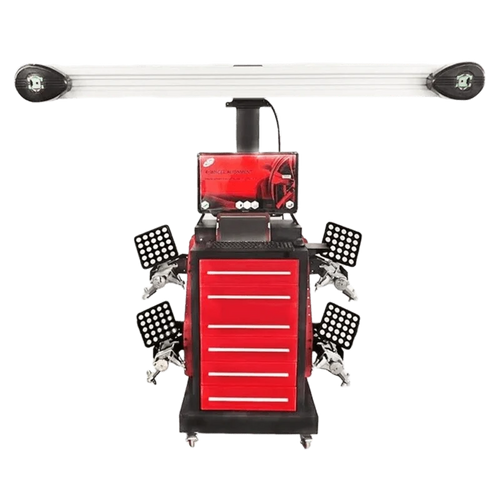
Measuring system. True 3D systems with rolling compensation read wheel position from targets tracked by cameras, and recompensate as the vehicle rolls. The Olympic AS800 is published as a true 3D system with rolling compensation, using a Sony 6.4 MP USB 3.0 camera and automatic synchronised camera beam tracking.
Clamping method. This is the one that shows up as a warranty argument later. Conventional rim clamps contact the wheel. Touchless designs clamp the tyre instead — the AS800 is published with three-point tyre adapters and no rim contact. On a shop that aligns alloy wheels all day, wheel-damage claims are a real cost centre, and clamping method is the spec that governs them.
Function coverage matters for what you can bill. The AS800's published function list covers toe, maximum turning angle, toe-out-on-turn, ride height, wheelbase, track width, offset and roll radius. Confirm the published function list against the work you actually sell before comparing two machines on headline capability.
Line item two: the rack — a standard lift will not do
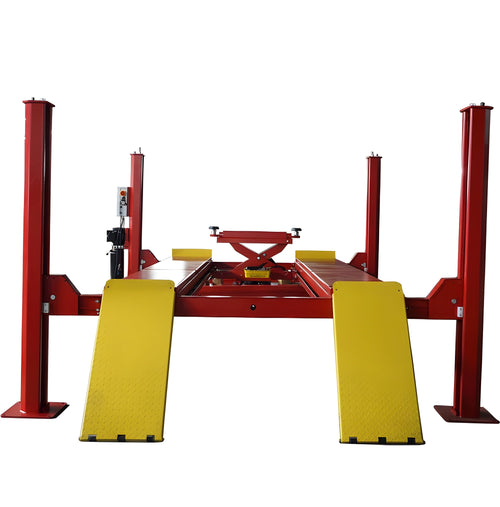
This is the single most common budgeting mistake. Alignment requires the wheels to be able to move freely while the vehicle is at working height and at a known, repeatable geometry. That means integrated turntables at the front and slip plates at the rear, built into the runways. A standard four-post storage lift has neither.
Olympic's open-front alignment lifts publish turntables and slip plates integrated directly into the runways, so the wheels respond freely during adjustment. If you already own a four-post lift, it is very unlikely to be convertible — treat the rack as a separate purchase, not an accessory.
There is a second pattern worth knowing. Some alignment machines are designed to work over a two-post or scissor lift rather than a dedicated rack, which changes the bay layout and the total spend considerably. Several Katool alignment machines are specified for use on two-post and scissor lifts. If floor space is your binding constraint rather than budget, that route is worth pricing alongside a dedicated rack.
Line item three: electrical service, the sleeper cost
Power is where an alignment bay quietly becomes an electrical project. The numbers our partners publish are not uniform, and the difference between them can be the cost of a new circuit or a new service.
The Olympic AS800 machine is published at 110 V, 60 Hz, single phase. The Olympic 4PHDXLA-14 rack is published at 220 V, 4 HP, 3 kW, 60 Hz, single phase. The heavy-duty Big-Rig alignment racks are published at 220/380 V, 3 kW, 60 Hz, three phase, drawing 15 / 8.8 amps.
If your building has no three-phase service, a heavy-duty rack may carry an electrical upgrade that rivals a meaningful share of the equipment itself. Establish what your building actually has before you shortlist a rack, not after. Where a vendor does not publish a voltage figure for a given model, ask for it in writing rather than assuming it matches a sibling model — as the table below shows, siblings in the same family do not always match.
Line item four: bay footprint and floor
An alignment bay needs the rack's footprint, plus room to open doors, plus room to walk the length of the vehicle with a turnplate lock in hand, plus somewhere for the machine's cabinet and camera beam to live with clear sightlines to the targets.
Work from published overall dimensions, not runway length. The runway is where the vehicle sits; the overall figure is what the bay must accommodate.
| Model | Capacity | Overall width | Overall length | Runway width | Lifting height | Power |
|---|---|---|---|---|---|---|
| Olympic 4PHDXLA-11 | 11,000 lb | 137.8 in | 246.06 in | 21.65 in | 70.86 in | Not published |
| Olympic 4PHDXLA-14 | 14,000 lb | 138 in | 246 in | 21.65 in | 70.9 in | 220 V, 3 kW, 1-phase |
| Olympic Big-Rig 22,000 | 22,000 lb | 152.4 in | 289.4 in | 25.6 in | 67 in | 220/380 V, 3-phase |
| Olympic Big-Rig 33,000 | 33,000 lb | 152.3 in | 289.3 in | 27.6 in | 67 in | 220/380 V, 3-phase |
All figures above are as published by Olympic Equipment for each model. Note the jump from the 14,000 lb class to the Big-Rig class: about 43 inches of extra length and a phase change. A bay that comfortably takes a 4PHDXLA-11 may not take a Big-Rig at all.
Two further floor questions belong in the budget rather than the install day. Alignment depends on a level, repeatable reference, so a floor that slopes to a drain across the rack's footprint is a problem to solve before delivery. And anchoring requirements vary by model — confirm the concrete depth and strength each specific model calls for in its installation documentation, because the requirement is model-specific and not interchangeable between families.
Line item five: commissioning, calibration and training
The machine arrives as freight, not as a working profit centre. Budget for the gap.
Calibration is the first item. A 3D system has to be calibrated in its installed position, and it needs recalibrating if the beam or cabinet is moved. Ask what the calibration interval is and what it costs, because it recurs.
Software is the second. Vehicle specification databases are how the machine knows target angles, and they date. The AS800 is published with multi-language support and yearly software updates; confirm what happens after the included period on any machine you shortlist.
Training is the third, and the most underrated. An alignment machine's accuracy is bounded by whoever runs it. The AS800 includes 3D training videos, which helps, but plan real bench time for the technician who will own the bay.
Finally, delivery. Heavy equipment ships as freight, and freight is curbside. Offloading a rack is your responsibility unless liftgate or inside delivery is arranged in advance. Our published transit estimate is 7 to 15 business days — an estimate, not a guarantee — and freight scheduling sits on top of it.
A checklist to run before you request a quote
- Measure the bay. Overall length and width, not just the runway. Compare against published overall dimensions for the specific model.
- Confirm your electrical service. Single or three phase, available amperage, and distance to the panel. Get the rack's published voltage in writing.
- Check the floor. Slope across the footprint, concrete depth and strength, and the anchoring requirement published for that exact model.
- Decide rack or over-lift. A dedicated alignment rack, or a machine specified to work over a two-post or scissor lift. This is the biggest single fork in the budget.
- Set the capacity from the heaviest vehicle you will ever align, not the average one — then leave headroom.
- Match the function list to what you bill. Toe-out-on-turn, ride height and track width are not on every machine.
- Ask about clamping. Rim contact or touchless. Then ask what the wheel-damage policy is.
- Get calibration interval, software renewal and training in writing before you compare two quotes, because they are rarely on the quote.
- Plan the offload. Curbside freight means a forklift or a liftgate, arranged ahead of delivery.
Work the list in that order and the quotes you collect become comparable. Skip it and the cheapest machine on paper is often the most expensive bay.
You can see the current range on our wheel alignment equipment and machines collection. Alignment racks sit with the 4 post car lifts, the over-lift route runs through scissor lifts, and the balancing side of the same bay is in wheel balancing and truing and the wider wheel service range.
Frequently asked questions
How much does an alignment machine cost?
Can I use an alignment machine on a 2 post lift?
What is a 3D alignment machine?
Do I need a special lift for wheel alignment?
What power supply does an alignment lift need?
Recommended equipment