How to Dispose of Old Tires: Options for Drivers, Tire Shops and Scrap Yards
Where to take old tires, why they cannot go in the trash, and how tire shops, farms and salvage yards cut scrap tire hauling costs with tire cutters, bead notchers and wheel crushers.

Key takeaways
- Most areas do not allow whole tires in household trash or landfills, so use a tire retailer, recycling center or licensed hauler.
- Many tire retailers take old tires for a small disposal fee when you buy new ones.
- Shops and yards pay haulers by volume or by tire, so cutting and nesting tires lowers cost per load.
- Wheel crushers separate tires from scrap wheels so the steel can be sold.
- Always check your state and local scrap tire rules.
Old tires pile up fast, and in most places you cannot simply throw them away. Whole tires take up space in landfills, trap water that breeds mosquitoes and can be a fire hazard, so most states regulate how scrap tires are stored, hauled and recycled. This guide covers how to dispose of old tires as a driver, and how tire shops, farms and salvage yards handle large volumes with tire recycling equipment.
How to dispose of old tires as a driver
- Leave them with the installer. When you buy new tires, most retailers take the old ones for a small disposal fee.
- Take them to a tire retailer. Many shops accept old tires even if you are not buying, usually for a per tire fee.
- Use a recycling center or transfer station. Many counties run tire collection days or accept tires at a transfer station. Fees and limits vary.
- Ask about rims. Some sites want tires off the rim. Scrap yards may buy the steel or aluminum wheels.
- Reuse. A tire in good condition can be sold or donated, and old tires can be used for some farm and garden projects where local rules allow.
Do not burn tires, dump them or put them in household trash. Check your state environmental agency or county solid waste office for the rules and fees in your area.
How tire shops and yards handle scrap tires
For a tire shop, fleet, farm or salvage yard, scrap tires are a running cost. Haulers often charge by the tire or by the load, and whole tires are mostly air. Processing tires on site reduces volume and can turn scrap steel into income.
| Equipment | What it does | Example |
|---|---|---|
| Tire cutter | Quarters tires or removes sidewalls so pieces nest densely | TC-50 G tire cutter, TC-55 G tire cutter, TC-125 tire cutter |
| Bead notcher | Notches the bead so a defective tire cannot be mounted again | TC-60 E bead notcher |
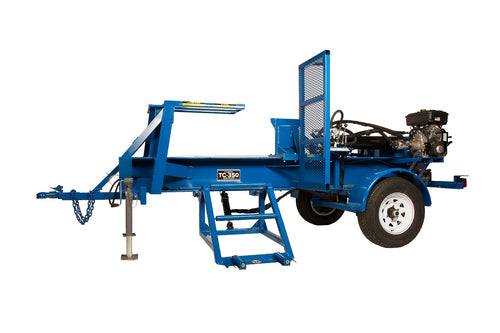
| Wheel crusher | Folds scrap wheels so tires come free and steel can be recycled | TC-300 D wheel crusher, TC-350 G wheel crusher |
Tire cutters
The TC-50 G tire cutter quarters passenger and light truck tires at up to 60 tires per hour on a 10 HP gas engine. The TC-55 G tire cutter quarters 17 inch and smaller tires at up to 90 per hour and 18 and 19 inch tires at up to 70 per hour on an 18 HP gas engine with electric start. For farm and construction tires, the TC-125 tire cutter cuts tires with a sidewall width of 24 inches or less and 20 ply or less, powered by a 49.6 HP Kubota diesel, and nesting cut tires can reduce volume by up to 60 percent.
Bead notchers
The TC-60 E bead notcher cuts a 1 1/2 inch notch into the bead of tires up to 11 x 24.5 inches so defective or unwanted tires cannot be mounted again. That helps shops make sure scrap tires stay out of resale.
Wheel crushers
When scrap tires are still on rusted wheels, a wheel crusher separates them in one stroke. The TC-300 D wheel crusher crushes passenger and light truck wheels 19 inches and smaller at up to 120 per hour and is equipped for towing. The TC-350 G wheel crusher handles over the road truck wheels, including Dayton and Budd types, with a hydraulic lift and a towable chassis.
Choosing tire recycling equipment
- Count the tires you scrap each month and their sizes.
- Compare your current hauling cost with the cost per load after cutting or nesting.
- Pick a power source that suits the site: gas, diesel or electric.
- Plan where tires, pieces and scrap steel will be staged.
- Check your state rules for storing and transporting processed tires.
What happens to recycled tires?
Scrap tires collected by licensed haulers go to processors that turn them into useful products. Common end uses include:
- Tire derived fuel for cement kilns, paper mills and power plants.
- Crumb rubber for playground surfaces, sports fields, mats and rubberized asphalt.
- Civil engineering uses such as lightweight fill and drainage layers where approved.
- Retreading for truck and bus casings that pass inspection.
- Steel recovery from bead wire and wheels, which goes back to steel mills.
Processing tires on site with a cutter or crusher does not replace your hauler, but it makes each load denser and cleaner, which is what most processors want. Keep records of how many tires leave your site and who hauls them, since many states require manifests for scrap tire shipments.
Tips for tire shops
- Post your disposal fee clearly so customers know the cost before the job.
- Store scrap tires covered or cut so they do not hold water.
- Separate tires that will be retreaded or resold from scrap.
- Ask your hauler whether they pay more or charge less for cut, nested or clean tires.
For a deeper look at cutters, read our tire cutter and recycling equipment guide. Browse tire cutters, wheel crushers and recycling balers, or call 888 896 7898 for help sizing equipment.