How to Choose a Tire Inflator Gauge: Analog vs Digital, Range and Accuracy
How to choose a tire inflator gauge: analog vs digital, which pressure range fits your tires, why accuracy matters at trail pressures and how the Power Tank Ventoso gauges compare.

Key takeaways
- Pick a range that covers your highest tire pressure with headroom.
- Digital gauges are easier to read at low trail pressures.
- Going over a gauge max pressure can peg an analog gauge.
- The RACER RED is rated at plus or minus 0.25 psi.
- Pair a gauge with high flow valve stems for the fastest air down.
A tire inflator gauge is the tool you hold at the tire every time you air down or air up. It sets how fast you work and how accurately you hit your pressure. This guide explains analog vs digital gauges, how to pick a pressure range, why accuracy matters at trail pressures and how Power Tank Ventoso gauges compare. For the airing down process itself, read how to air down tires.
What does a tire inflator gauge do?
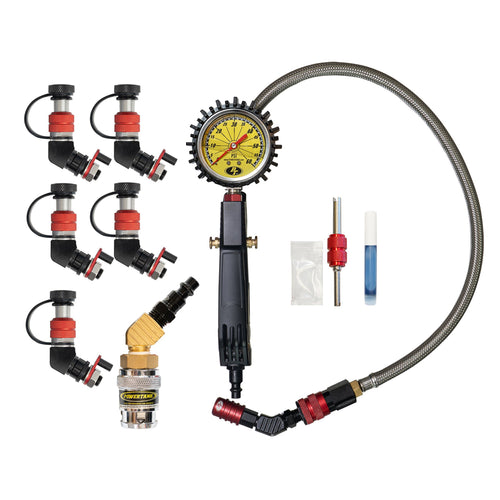
An inflator gauge combines a chuck, a pressure gauge and a valve in one hand tool. You connect it to the tire, read the pressure, then add air from a CO2 tank or compressor or bleed air off to air down. A good one reads clearly, flows freely and holds its accuracy over time.
Analog vs digital tire inflator gauges
| Analog | Digital | |
|---|---|---|
| Reading | Needle on a dial | Numeric display |
| Low pressure readability | Harder to read small changes | Easy to read in tenths at trail pressures |
| Power | None needed | Battery |
| Risk | Can be pegged by going over max pressure | Range limits still apply |
| Best for | Simple everyday use | Precision, low pressures, racing |
Power Tank notes that if an analog gauge does not return to zero, it has probably been pegged by going over its maximum, for example attaching a 60 psi gauge to a tire holding 65 psi. That is why range matters.
Choose the right pressure range
Pick a gauge whose range covers your highest pressure with some headroom. A 60 psi gauge reads low trail pressures with more resolution, while a 150 psi gauge covers truck, trailer and RV tires. The Power Tank Ventoso lineup offered on its CO2 systems:
| Gauge | Type | Range | Best for |
|---|---|---|---|
| Trooper | Analog | 0 to 60 psi | Everyday trail use |
| Rubicon | Digital | 1.5 to 60 psi | Easy low pressure reading |
| Long-Haul | Analog | 0 to 150 psi | Truck and trailer tires |
| Work Horse | Digital | 5 to 150 psi | Mixed fleets and higher pressures |
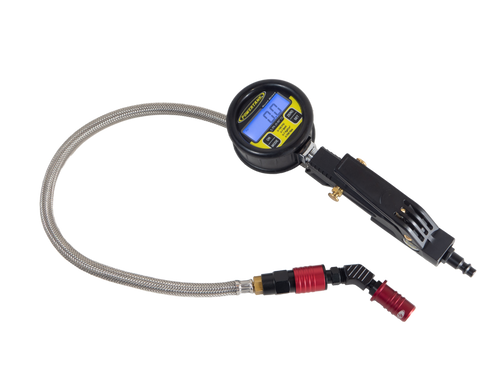
| RACER Series | Precision digital | 0 to 100 psi | Most accurate, plus or minus 0.25 psi |
Why accuracy matters off road
At 12 psi, a gauge that is off by 2 psi is off by more than 15 percent, which changes traction, ride and the risk of unseating a bead. The Ventoso RACER RED digital tire inflator gauge is Power Tank's most precise option, rated at plus or minus 0.25 psi. Each gauge is serialized, tested and shipped with a certificate of accuracy, and the Ventoso RED body is rebuildable. Not sure where to start? Our air down guide covers typical starting pressures.
Hose, chuck and input fitting
Look for a flexible hose whip with swivels, a chuck that seals quickly on the valve and an input plug that matches your air source. The RACER RED uses a 2 ft stainless steel whip with swivels, a Quick Switch coupler with a HiPPO push on chuck and a 1/4 in industrial plug input. It also works with a shop or portable compressor that uses the same plug.
Speed up the job with high flow valve stems
A standard Schrader valve core limits flow in both directions. Power Tank Monster Valves are large diameter secondary valve stems that air down far faster and cut inflation time, and you keep your original stem for quick pressure checks. See the Monster Valve Primary 5 pack, which Forgeline also offers bundled with a Ventoso RED gauge, and the high flow valve stems collection.
Tire inflator gauge checklist
- Range covers your highest pressure with headroom.
- Digital if you run low trail pressures or want precision.
- Published accuracy rating, ideally with a certificate.
- Hose with swivels and a fast sealing chuck.
- Input plug that matches your CO2 tank or compressor.
- Rebuildable body and available replacement parts.
- A case to keep sand and dirt out.
Products to consider
- Ventoso RACER RED digital tire inflator gauge: 0 to 100 psi, plus or minus 0.25 psi.
- Monster Valve Primary 5 pack: high flow stems, with optional Ventoso RED gauge.
- Power Tank 10 lb CO2 Tire Inflation System: choose any Ventoso gauge with your system.
- 15 lb CO2 Tire Inflation System: the same gauge choices on a 15 lb tank.
Shop all tire inflator gauges or CO2 tire inflation systems.
Related guide: thinking about nitrogen instead of air? Read our nitrogen tire inflation guide.
Frequently asked questions
Is a digital or analog tire inflator gauge better?
What psi range should my tire inflator gauge have?
Why does my analog gauge not read zero?
How accurate is the Ventoso RACER RED?
Can I use a tire inflator gauge as a tire deflator?
Will a Ventoso gauge work with an air compressor?
What tire pressure should I run off road?
Recommended equipment