Hollow Hydraulic Cylinders: What They Are Used For and How to Choose One
A guide to hollow plunger, or center hole, hydraulic cylinders: how they work, common pulling, tensioning and testing jobs, and what to check before you buy.

Key takeaways
- A hollow cylinder has a hole through the plunger so a rod, bolt or puller can pass through it.
- Pushing against a nut on the rod turns the push into a pull.
- Common jobs: pulling bearings and gears, tensioning bolts and rods, and proof testing anchors.
- Check the center hole diameter as well as tonnage and stroke.
- Threaded plungers accept attachments; no thread versions are for plain bearing contact.
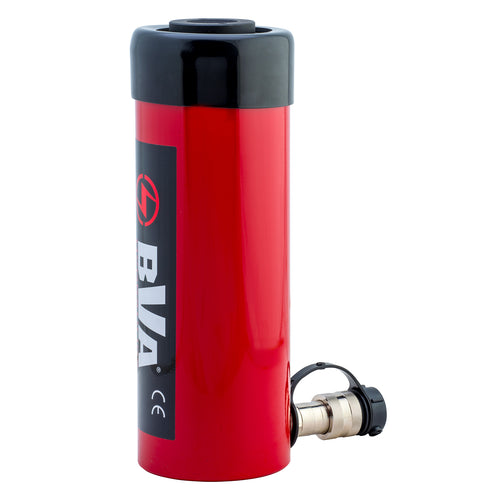
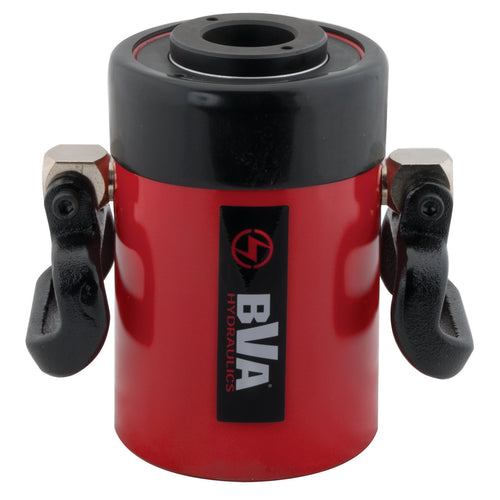
A hollow hydraulic cylinder, also called a hollow plunger, hollow hole or center hole cylinder, has a hole running all the way through its body and plunger. A rod, bolt or puller screw passes through the center. That simple change lets one cylinder push, pull and tension, which makes it one of the most versatile tools in maintenance and construction hydraulics.
How a hollow plunger cylinder works
Like any single acting cylinder, oil pressure pushes the plunger out. The difference is what you do with that push. Feed a threaded rod through the center hole, put a nut and plate on the end, and as the plunger extends it pushes against the nut, pulling the rod toward the cylinder. The force is the same as the push rating; it is just applied along the rod. Most hollow cylinders in this class run at a maximum of 10,000 psi and return by an internal spring.
Common uses
- Pulling bearings, gears, pulleys and bushings with a puller set or through bolt.
- Tensioning rods, tendons and bolts, including post tensioning work.
- Proof testing anchors, bolts and fixings by pulling to a set load.
- Pressing pins and shafts where a rod has to pass through the work.
- Jacking and positioning in fixtures where a through rod guides the load.
What to check before you buy
| Spec | Why it matters |
|---|---|
| Capacity (tons) | Must exceed the pull or tension needed, with a margin |
| Center hole diameter | Must clear the rod, bolt or puller screw you will use |
| Stroke | Sets how far you can pull in one stroke before resetting the nut |
| Collapsed height | Must fit the space between the work and the nut |
| Plunger thread | Threaded plungers take attachments; no thread versions bear directly on a plate |
| Return | Most are spring return single acting; heavy duty versions may be double acting |
Calculate force with our hydraulic cylinder force calculator, and compare styles in how to choose a hydraulic cylinder.
Pumps, hoses and gauges
A hollow cylinder needs a pump with enough usable oil for its stroke, a hose and coupler rated for 10,000 psi, and ideally a gauge so you can read the load. Hand pumps suit occasional pulling; air or electric pumps suit repeated tensioning. See hydraulic pump types and couplers, hoses and gauges.
Safety tips
- Use rods, nuts and plates rated above the cylinder force.
- Keep the rod centered in the hole; side loads damage the plunger and seals.
- Stand clear of the line of the rod in case anything breaks.
- Never exceed the rated stroke or capacity.
- Inspect the plunger and threads before each use.
Hollow cylinder vs standard cylinder
| Hollow plunger cylinder | Standard solid ram | |
|---|---|---|
| Center hole | Yes, through body and plunger | No |
| Push | Yes | Yes |
| Pull with a through rod | Yes | No, needs a pull cylinder or puller frame |
| Typical jobs | Pulling, tensioning, testing | Lifting, pressing, pushing |
| Size for the same tonnage | Usually larger diameter | More compact |
If you only push and lift, a standard cylinder is usually smaller and simpler. If you need to pull through a part, tension a rod or test an anchor, a hollow cylinder does the job with one tool.
Hollow cylinders we carry
- BVA Hydraulics HC1202T 12 ton hollow hole cylinder
- BVA Hydraulics HC3006T 30 ton hollow hole cylinder
- Williams 6CH30T06 30 ton hollow hole cylinder
- BVA Hydraulics HC6003T 60 ton hollow hole cylinder
Shop all hydraulic cylinders or the BVA Hydraulics and Williams ranges.
Frequently asked questions
What is a hollow hydraulic cylinder used for?
How does a hollow plunger cylinder pull?
Is a hollow cylinder as strong as a solid cylinder?
What size center hole do I need?
Are hollow cylinders single acting?
What pump do I need for a hollow cylinder?
Recommended equipment