Hydraulic Cylinder Force Calculator: Tons From PSI and Bore Size
Work out how much force a hydraulic cylinder makes from its bore and the pump pressure, with a ready made force chart at 10,000 psi, retract force for double acting cylinders and how to size a cylinder for a job.

Key takeaways
- Force in pounds equals pressure in psi times effective area in square inches.
- Area of a round bore is 3.1416 times the diameter squared, divided by 4.
- Divide pounds by 2,000 to get US tons.
- Retract force on a double acting cylinder uses the bore area minus the rod area.
- Pick a cylinder rated above the load, with a margin, at your pump pressure.
Every hydraulic cylinder follows the same simple rule: force equals pressure times area. If you know the pump pressure and the effective area of the cylinder, you can work out its force, check whether a cylinder is big enough for a job, or turn a gauge reading into tons. This page works as a quick hydraulic cylinder force calculator with the formula, a chart and worked examples.
The hydraulic cylinder force formula
Force (lb) = Pressure (psi) x Effective area (sq in)
For a round piston, Area = 3.1416 x diameter x diameter / 4. To convert to US tons, divide pounds by 2,000. To convert to metric tonnes, divide pounds by 2,204.6.
Worked example
A cylinder with a 2 inch bore has an area of 3.1416 x 2 x 2 / 4 = 3.14 sq in. At 10,000 psi it produces 3.14 x 10,000 = 31,416 lb, which is about 15.7 tons. At 5,000 psi the same cylinder makes half that, about 7.9 tons.
Cylinder force chart at 10,000 psi
Most portable and shop hydraulic systems in the BVA Hydraulics, Porto-Power and Williams ranges run at a maximum of 10,000 psi. This chart shows push force by bore diameter at that pressure:
| Bore diameter | Effective area | Force at 10,000 psi | Force in US tons |
|---|---|---|---|
| 1 in | 0.79 sq in | 7,854 lb | 3.9 tons |
| 1.5 in | 1.77 sq in | 17,671 lb | 8.8 tons |
| 2 in | 3.14 sq in | 31,416 lb | 15.7 tons |
| 2.5 in | 4.91 sq in | 49,087 lb | 24.5 tons |
| 3 in | 7.07 sq in | 70,686 lb | 35.3 tons |
| 3.5 in | 9.62 sq in | 96,211 lb | 48.1 tons |
| 4 in | 12.57 sq in | 125,664 lb | 62.8 tons |
| 5 in | 19.63 sq in | 196,350 lb | 98.2 tons |
| 6 in | 28.27 sq in | 282,743 lb | 141.4 tons |
Cylinder makers publish the effective area for each model, so use that figure when you have it. The rated tonnage of a cylinder is its force at maximum working pressure.
Retract force on a double acting cylinder
A double acting cylinder also uses oil to retract. On the retract side the rod takes up part of the piston face, so the effective area is the bore area minus the rod area. That is why retract force is always lower than push force. Example: a 3 inch bore with a 2 inch rod has 7.07 - 3.14 = 3.93 sq in on the retract side, about 39,270 lb or 19.6 tons at 10,000 psi. See single acting vs double acting cylinders.
Turning a gauge reading into tons
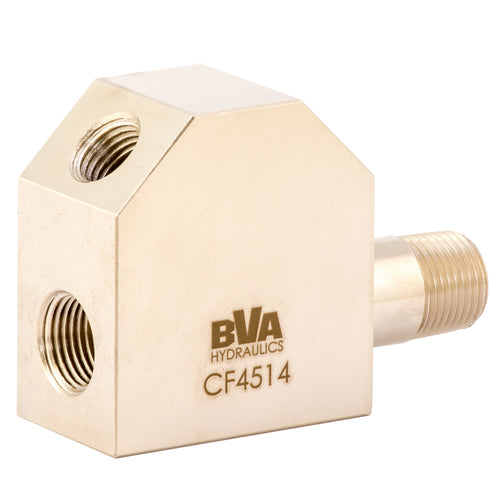
A pressure gauge in the line between pump and cylinder shows how hard the cylinder is pushing. Multiply the gauge reading by the cylinder effective area and divide by 2,000. With a 3.14 sq in cylinder, 6,000 psi on the gauge means 3.14 x 6,000 / 2,000 = about 9.4 tons. A BVA Hydraulics CF4514 gauge adapter lets you fit a gauge at the pump or cylinder.
Pressure needed to move a load
Flip the formula to find the pressure a job needs: Pressure (psi) = Load (lb) / Effective area (sq in). Lifting a 20,000 lb load with a 3.14 sq in cylinder needs about 6,370 psi, well inside a 10,000 psi system.
How to size a cylinder
- Find the load in pounds or tons, including fixtures.
- Add a margin so the cylinder works below its maximum rating. Many shops size for about 80 percent of the rated capacity.
- Check the stroke covers the travel, and the collapsed height fits under the load.
- Choose single or double acting, and a style such as standard, low profile, hollow plunger or lock nut. See how to choose a hydraulic cylinder.
- Match the pump oil capacity to the cylinder volume: area x stroke gives cubic inches of oil.
Cylinder oil volume
The oil needed to extend a cylinder is effective area x stroke. A 3.14 sq in cylinder with a 6 inch stroke needs about 18.8 cubic inches of usable oil. Pick a pump whose usable oil is larger than the total volume of the cylinders it runs. See our hydraulic pump types guide.
Products to consider
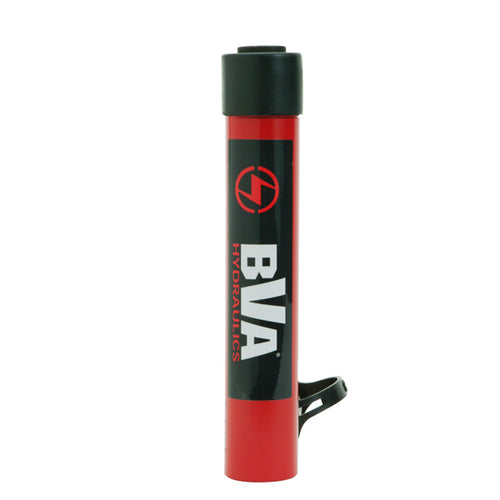
- BVA Hydraulics H0505 5 ton cylinder
- BVA Hydraulics H10002A 100 ton cylinder
- BVA Hydraulics CF4514 gauge adapter
Shop all hydraulic cylinders, hydraulic hand pumps and gauges and fittings.
Frequently asked questions
How do you calculate hydraulic cylinder force?
How much force does a 2 inch hydraulic cylinder have?
What is the effective area of a hydraulic cylinder?
Why is retract force lower than push force?
How do I convert psi to tons on a hydraulic press?
What pressure do portable hydraulic cylinders use?
How much oil does a hydraulic cylinder need?
Recommended equipment