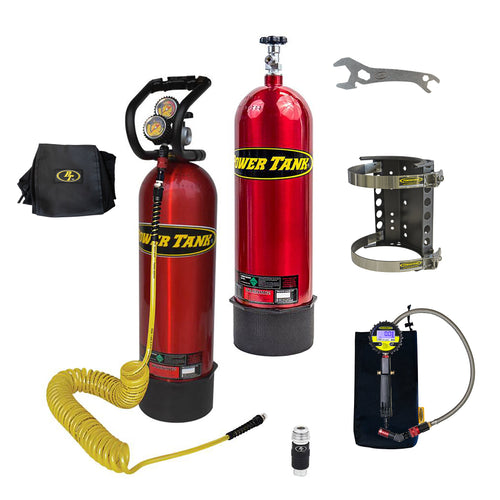
CO2 vs Air Compressor for Airing Up Tires: Which Off Road Air Source Is Right for You?
A CO2 tank airs up tires faster and runs air tools with no wiring, while a 12V off road air compressor never needs a refill. This guide compares the two and explains how to choose.

A CO2 tank airs up tires much faster than most 12V compressors, needs no wiring and runs air tools, but it has to be refilled. An off road air compressor makes air for as long as your battery and alternator hold out, but it is slower and has to be wired in or plugged into a power source. If you air down most weekends and want to get back on the road quickly, CO2 is hard to beat. If you rarely air down and never want to think about refills, a compressor makes sense. Many rigs carry both.
How a CO2 tank airs up tires
A CO2 system stores liquid CO2 in a cylinder. A high flow regulator lets gas off at a set working pressure, and a hose and tire inflator gauge deliver it to the tire. Power Tank's XP PRO regulator flows about 60 cfm at 0 psi and adjusts up to 400 psi. There is no motor to warm up, no duty cycle and nothing pulling current from your battery.
How an off road air compressor works
A 12V compressor uses an electric motor to drive a piston and pump air, either into the tire directly or into a small tank. Flow depends on the model, but portable and onboard 12V units have much lower flow ratings than a high flow CO2 regulator, so each tire takes longer. Many 12V compressors also have a duty cycle, which means they have to rest after a period of running. Shop air compressors with large tanks are a different class of machine and are not built to ride in an off road rig.
CO2 vs compressor: side by side
| Factor | CO2 tank (Power Tank) | 12V off road compressor |
|---|---|---|
| Fill speed | Fast; XP PRO flows about 60 cfm at 0 psi | Slower; depends on motor size |
| Power needed | None | Battery and alternator, wiring or a plug |
| Duty cycle | None | Often limited on smaller units |
| Air tools | Runs impact wrenches and other air tools | Limited on most portable 12V units |
| Bead seating | High flow output can reseat beads | Often struggles without a tank |
| Noise | Quiet | Motor noise while running |
| Running out | Needs a refill or exchange | Makes air as long as power holds |
| Installation | Portable or bolt on mount | Often hard wired, with mounting and wiring |
When is CO2 the better choice?
- You air down often. Faster fills mean less time at the trailhead every trip.
- You run large tires. Big tires take a lot of air; high flow shortens the wait.
- You want to run air tools. Power Tank systems run impact wrenches and other air tools on the trail.
- You do not want to wire anything. A CO2 tank can move between vehicles.
- You ride a UTV. A Power Shot 20 oz system mounts to the cage and adds about 10 psi to seven 29 inch tires with no battery draw.
When is a compressor the better choice?
- You rarely air down and mainly want something for the occasional low tire.
- You never want to think about refills or have no CO2 supplier nearby.
- You already have an onboard compressor for air lockers and want to keep it.
Do you need both?
Plenty of off roaders run an onboard compressor for lockers and keep a CO2 tank for fast fills, bead seating and air tools. Others go CO2 only and carry a spare bottle on long trips. Think about where the time goes today. If you spend too long at the trailhead airing up, CO2 closes that gap.
How to choose: a CO2 vs compressor checklist
- Count how many times a month you air down and back up.
- Note your tire size and how many tires you air up, including friends and trailers.
- List any air tools, lockers or shocks you want to run.
- Check your electrical system and whether you want to add wiring.
- Find your nearest CO2 refill or exchange source.
- Decide where a tank or compressor will mount.
CO2 systems to consider
- Power Tank 10 lb CO2 Tire Inflation System: the most popular size for mid size rigs.
- Power Tank 15 lb Dual Bottle System: the most CO2 Power Tank packs into one kit.
- Power Shot Trigger Solo: a cage mounted 20 oz system for UTVs.
- Workman Power Shot Sidearm Kit: a belt mounted 20 oz system that delivers about as much air as a 50 gallon tank at 120 psi.
Ships empty. Fill at a local welding supply, fire extinguisher, paintball or beverage CO2 supplier before first use. Power Tank products ship free to the contiguous U.S. and usually leave Power Tank within two business days. Browse CO2 tire inflation systems and UTV CO2 air systems, read the CO2 tire inflation system buying guide, or learn how to air down tires.
Frequently Asked Questions
Is CO2 faster than an air compressor for airing up tires?
In most off road setups, yes. A high flow CO2 regulator like the Power Tank XP PRO flows about 60 cfm at 0 psi, far more than typical 12V compressors, so tires fill faster.
Can a CO2 tank run air tools?
Yes. Power Tank systems run impact wrenches and other air tools on the trail. Tool use draws CO2 faster than airing up tires.
Does CO2 hurt tires or wheels?
No. CO2 is widely used to air up off road tires. CO2 can seep through rubber a little faster than air over time, so check pressures before your next drive.
What happens when the CO2 tank is empty?
You refill or exchange it at a gas supplier. A spare bottle or dual bottle kit keeps a full tank ready.
Is a CO2 tank good for UTVs and side by sides?
Yes. Power Shot 20 oz systems mount to the roll cage, need no battery power and can reseat a bead on the trail.
Recommended equipment