CO2 Tire Inflation System Buying Guide: How to Choose the Best CO2 Tire Inflator for Off Road
How to choose a CO2 tire inflation system for off road: tank size, regulator flow and pressure, hoses and gauges, mounting and refills, with a checklist and example Power Tank systems.

A CO2 tire inflation system stores compressed CO2 in a bottle and meters it through a high flow regulator, so you can air up off road tires in a fraction of the time a 12V compressor takes. For most Jeeps, Broncos, Tacomas and 4Runners, a 10 lb system is the right starting point. If you run 37 inch or larger tires, air up a group or want more trips between refills, a 15 lb or dual bottle system fits better.
What is a CO2 tire inflation system?
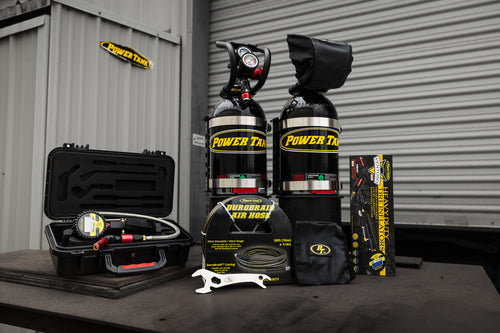
A complete system has four parts: a CO2 cylinder with an on/off valve, a regulator that drops tank pressure down to a usable working pressure, a hose, and a tire inflator gauge or chuck. Liquid CO2 in the bottle boils off into gas as you draw from it, which is why a small bottle holds so much usable air. Because there is no motor, there is nothing to wire, no duty cycle to wait out and no moving parts to wear.
Power Tank systems are built around the XP PRO regulator with the Super Flow coupler. It adjusts up to 400 psi and flows about 60 cfm at 0 psi, which is enough to air up tires quickly, reseat a bead on the trail, run an impact wrench and fire air lockers or air shocks from the same tank.
10 lb vs 15 lb CO2 tank: which size do you need?
| Factor | 10 lb system | 15 lb system |
|---|---|---|
| Best fit | Jeeps, Broncos, Tacomas, 4Runners and mid size rigs | Full size trucks, 37 inch and larger tires, group runs |
| CO2 on board | Standard | 50% more CO2 than the 10 lb |
| Size and weight | Easier to mount inside the cab or on a ladder | Larger bottle, plan the mount before you buy |
| Who it suits | Most solo trail drivers | Drivers who air up friends or run big tires often |
Power Tank describes the 10 lb as enough CO2 to air a full set of off road tires back up several times. How many fills you actually get depends on tire size, how far you air down and how much you use air tools, so if you are on the fence, choose the larger tank or add a spare bottle.
Single bottle or dual bottle?
A dual bottle kit adds a second cylinder, so one stays full in the garage or trailer while the other rides in the rig. Swapping the regulator over takes about a minute. The 10 lb dual and 15 lb dual packages suit long trips, shop use and anyone who hates running out. The Overlander packs two 10 lb bottles for overland travel. You can also add a spare CO2 bottle to a single bottle system later.
What to look for in a CO2 regulator
- Flow. Flow decides how fast tires fill. The XP PRO is rated about 60 cfm at 0 psi. The HP250i Super Flow kit flows about 45 cfm and adjusts up to 250 psi.
- Freeze resistance. CO2 gets very cold as it expands. Regulators built for high flow, like the HP250i, are designed not to freeze clog.
- Adjustable output. Tires need a low working pressure, while some air tools and lockers want more. An adjustable regulator lets one tank do both.
- Exchange tanks. If your gas supplier only swaps tanks, the HP250i fits almost any U.S. made CO2 bottle from 5 to 20 lb.
Compare all of our CO2 regulators.
Hoses, gauges and valve stems
Power Tank 10 lb and 15 lb systems let you choose a tire inflator gauge and a coiled or straight 30 ft hose, which reaches all four tires and a trailer without moving the tank. A precise gauge matters when you air down; the Ventoso RACER RED is rated to plus or minus 0.25 psi. To cut fill and deflate times further, Monster Valve high flow valve stems replace or add a larger stem on each wheel.
Mounting and carrying the tank
Plan where the tank rides before you order. Track Pack versions of the 10 lb and 15 lb systems include a padded speed bag for carrying. For a fixed mount, see our CO2 tank mounts, including roll bar plates for the 2021+ Ford Bronco and a wide ladder cross bar mount.
How to choose: a CO2 tire inflation system checklist
- Note your tire size and how far you usually air down.
- Decide whether you will air up only your own rig or a group.
- Pick 10 lb for most mid size rigs, 15 lb for 37 inch and larger tires or frequent group use.
- Decide whether you want a spare bottle now, or plan to add one later.
- List any air tools, air lockers or air shocks you want to run from the tank.
- Choose your gauge and a coiled or straight hose.
- Plan the mount: in the cab, on the roll bar, on a ladder or in a carry bag.
- Find a local CO2 refill or exchange source before your first trip.
Systems to consider
- Power Tank 10 lb CO2 Tire Inflation System, Single Bottle: the most popular size for mid size off road rigs.
- Power Tank 15 lb CO2 Tire Inflation System, Single Bottle: 50% more CO2 for big tires and group runs.
- Power Tank 10 lb Dual Bottle System: a spare bottle so one is always full.
- Power Tank Overlander 10 lb Dual Bottle: two bottles packaged for long trips.
- HP250i Super Flow Regulator Kit: turns an exchange CO2 tank into a Power Tank.
Ships empty. Fill at a local welding supply, fire extinguisher, paintball or beverage CO2 supplier before first use. Power Tank products ship free to the contiguous U.S. and usually leave Power Tank within two business days. Browse all CO2 tire inflation systems, compare CO2 vs an air compressor, or see the full Power Tank lineup.
Frequently Asked Questions
How long does a 10 lb CO2 tank last?
It depends on tire size, how far you air down and whether you run air tools. Power Tank describes the 10 lb as enough to air a full set of off road tires back up several times. Larger tires and frequent tool use shorten that, so many drivers choose a 15 lb tank or keep a spare bottle.
Is CO2 safe for tires?
Yes. CO2 is widely used for airing up off road tires. Over time CO2 can seep through tire rubber a little faster than air, so check your pressures before your next drive, as you should anyway.
Can I refill a Power Tank myself?
Refills are done by a gas supplier. Most welding gas suppliers refill CO2 cylinders, and many beverage gas, fire extinguisher and paintball shops do too. If your supplier only does exchanges, the HP250i regulator kit fits most U.S. made exchange bottles.
Will a CO2 system reseat a tire bead?
Yes. The high flow output of Power Tank regulators can reseat beads on the trail, which most small 12V compressors cannot do quickly.
Can I run an impact wrench from a CO2 tank?
Yes. Power Tank systems run impact wrenches and other air tools on the trail. Heavy tool use draws CO2 faster than airing up tires, so size your tank accordingly.
Recommended equipment