Car Lift Garage Fit Calculator: Ceiling Height, Bay Size and Lift Dimensions
Enter your ceiling height, vehicle height and bay size to see which 2 post, 4 post, scissor or parking lift fits your garage, how high you can raise the car, and whether you can stand under it.
Key takeaways
- Measure to the lowest overhead obstruction, such as the open garage door or opener, not just the ceiling.
- Ceiling needed equals lifted height plus vehicle height plus a 3 to 6 inch margin.
- Standing under a car takes about 68 to 72 inches of lifted height, or roughly 11 to 12 feet of clear height for a sedan.
- Under 10 feet, a mid rise scissor lift is usually the best fit. At 12 feet or more, almost any lift works.
- After the ceiling, check bay width, slab thickness and power for the exact model.
Before you buy a car lift, you need three numbers from your garage: the height to the lowest thing on the ceiling, the width of the bay, and the depth of the bay. Put those into the calculator below with the height of your vehicle, and it tells you which lift types fit, how high you can actually raise the car, and whether you will be able to stand under it.
The rest of this guide explains the math behind the calculator, the typical dimensions of 2 post, 4 post, scissor and parking lifts, and the slab and power checks that come after the ceiling question.
Car lift garage fit calculator
Example numbers are filled in (10 ft ceiling, 66 in crossover). Replace them with your own measurements. Results update as you type.
Enter your measurements to see which lift types fit.
Results are estimates. Confirm the exact numbers on the spec sheet of the model you choose. Slab: published minimums on the 2 post lifts we carry range from 4 to about 6 in of 3,000 psi concrete; follow the manual for your model. Power: most 2 post lifts list 220V single phase, while many 4 post storage and some scissor lifts list 110V. See the ceiling, concrete and power requirements guide.
How to measure your garage for a car lift
Measure with a tape or laser and write every number in inches. Ten minutes of measuring now prevents a lift that cannot reach working height, or a column that will not stand up under a beam.
- Ceiling height at the lift spot. Measure from the finished floor to the ceiling where the lift will stand, not at the door. Many garage floors slope toward the door, so measure at both ends of the bay and use the lower number.
- Lowest overhead obstruction. This is the number that really matters. Measure to the bottom of the garage door when it is open, the door track, the opener rail and motor, light fixtures, beams, ducts and sprinkler heads. Your usable height is the lowest of these, not the drywall.
- Bay width. Measure wall to wall, or wall to the next parked car, at the narrowest point. Shelves and cabinets count as walls.
- Bay depth. Measure from the back wall to the inside of the closed garage door.
- Vehicle height. Look up the height of the tallest vehicle you will lift in its spec sheet, then add roof racks, light bars or a tall antenna.
- Slab thickness. Drill a small test hole where the lift posts will stand, or check your building plans. You also want to know if the slab has cracks or control joints near the post locations.
- Power. Check whether a 220V circuit is available near the lift spot, or how far your electrician would need to run one.
The ceiling height formula
Every lift fit question comes down to one simple sum:
Ceiling needed = lifted height + vehicle height + safety margin
Lifted height is how high the lift raises the car. On a 4 post lift or a scissor lift that is the height of the runway or platform surface. On a 2 post lift it is the height of the lift pads. The car sits on its frame or pinch welds, a few inches above the bottom of the tires, so a 2 post lift actually puts the roof a little lower than this formula says. That makes the formula a safe, conservative check.
Safety margin is the gap you leave between the roof and the ceiling. Use at least 3 inches, and 6 inches is better. Many lifts have an overhead shutoff bar or an adjustable top lock position, so you can stop the lift before the roof reaches the ceiling.
Turn the formula around and you get the question most buyers really have: how high can I raise my car in this garage? Take your lowest overhead obstruction, subtract the vehicle height and the margin, and you have your maximum usable lifted height. The calculator does this for you and compares it with the rise of each lift type.
Example: a 10 foot ceiling and a crossover
A 10 foot ceiling is 120 inches. A crossover that is 66 inches tall with a 4 inch margin leaves 120 minus 66 minus 4, which is 50 inches of usable lift. That is plenty for a mid rise scissor lift, which raises the car about 40 to 48 inches for wheel, brake and suspension work. It is not enough to stand under the car, which takes roughly 68 to 72 inches for most adults.
Example: a 12 foot ceiling and a pickup
A 12 foot ceiling is 144 inches. A pickup that is 76 inches tall with a 4 inch margin leaves 64 inches of usable lift. You could raise it on a 2 post lift and work under it bent over, or lift a lower car all the way. For full standing height under a tall truck, plan on 13 to 14 feet of clear height.
Typical car lift dimensions by type
The ranges below come from the spec sheets of the 2 post, 4 post and scissor lifts we carry. Always confirm the exact numbers on the spec sheet of the model you choose.
| Lift type | Lifted height (rise) | Overall lift height | Space it needs | Best fit |
|---|---|---|---|---|
| 2 post, floor plate | About 70 to 75 in | About 110 to 115 in (9 ft 2 in to 9 ft 7 in) | About 11 to 12 ft wide, 20 ft or more deep | Repair work in garages with ceilings around 10 to 12 ft |
| 2 post, clear floor (overhead) | About 70 to 80 in | About 140 to 176 in (11 ft 8 in to 14 ft 8 in) | About 11 to 12.5 ft wide, 20 ft or more deep | Shops and tall garages that want an open floor |
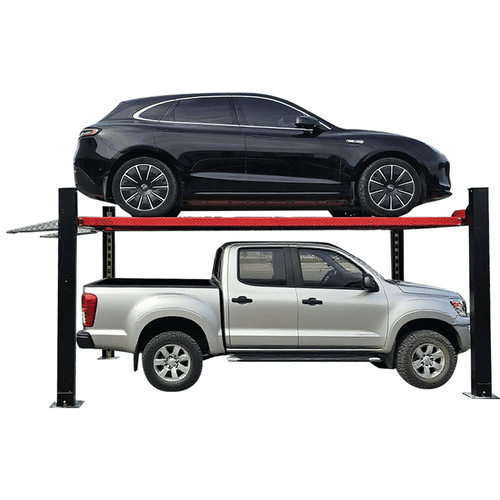
| 4 post storage and service | About 70 to 92 in | Posts usually 7 to 9 ft tall | About 9 to 11 ft wide, 18 to 22 ft long | Storage, oil changes and parking a second car underneath |
| Parking lift (car stacker) | About 72 to 92 in | Posts usually 7 to 9 ft tall | About 9 to 11 ft wide per car, 18 to 22 ft long | Two cars in one bay |
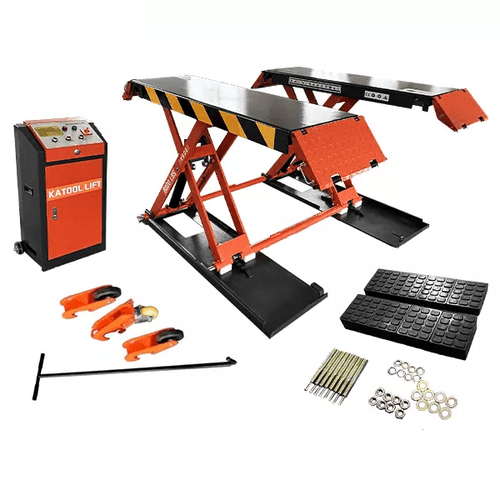
| Mid rise scissor | About 39 to 48 in | Flat on the floor when lowered | A normal parking space | Low ceilings, wheels, brakes and detailing |
| Full rise scissor | About 72 to 76 in | Flat on the floor when lowered | About 7 ft wide, 15 to 18 ft long platform | Full height work with no posts in the way |
Two numbers to watch on a 2 post lift: a floor plate lift has a shorter column but a plate across the floor, and a clear floor lift has an overhead beam that needs a taller ceiling. If your ceiling is under about 12 feet, a floor plate model is usually the realistic 2 post choice.
What ceiling height do you need for each lift type?
2 post lifts
For a floor plate 2 post lift, the column itself needs about 9 feet 2 inches to 9 feet 7 inches plus a small gap. The real limit is the car: to raise an average sedan to full height you want around 11 to 12 feet of clear height. In a 10 foot garage you can still use one, you just stop short of full rise. Clear floor 2 post lifts need the ceiling to be taller than the overhead beam, so plan on 12 feet or more. Browse our 2 post car lifts and compare the column height on each spec sheet.
4 post lifts
A 4 post lift lifts the whole car on runways, so the roof goes up by the full rise. For storage of one car above another, the ceiling usually needs to be at least 11 to 12 feet, and taller vehicles need more. For service work with a rolling jack, the same formula applies. See our 4 post car lifts.
Parking lifts and car stackers
A stacker has two fit checks. The lower car has to fit under the raised runway with a few inches to spare, and the upper car has to fit under the ceiling. A useful rule: add the heights of both cars, add about 5 to 6 inches for the runway and drip trays, then add your margin. Two 56 inch sports cars can share a bay with about 10 feet 6 inches, while a sedan over a crossover needs closer to 11 feet 6 inches. Browse parking lifts.
Scissor lifts
Mid rise scissor lifts are the go to choice for low ceilings. Because they lower flat and raise the car 39 to 48 inches, they work under 8 to 10 foot ceilings that will not take a post lift. Full rise scissor lifts reach 72 inches or more and need the same headroom as a 4 post lift. Shop our scissor lifts.
Bay width and depth
Ceiling height gets the attention, but width and depth are where many installs get tight.
- 2 post lifts need the width of the lift, roughly 11 to 12.5 feet outside the columns, plus room on both sides to open doors and walk around. A 13 foot wide bay is a practical minimum for the narrower models, and 14 feet or more is better.
- 4 post lifts and stackers are about 9 to 11 feet wide and 18 to 22 feet long. Add about 2 feet of walkway on at least one side and room behind the ramps to drive on.
- Scissor lifts fit in a normal parking space. Mid rise units are often portable, so they can roll out of the way when you need the bay back.
- Garage door clearance. If the open door or its track crosses the lift area, the door is your ceiling. Many owners convert to a high lift track or a wall mount opener to gain space.
Concrete and power checks
Once the lift fits, the slab and the circuit decide whether you can install it safely.
- Concrete. Published minimums on the 2 post lifts we carry range from 4 to about 6 inches of 3,000 psi concrete, and heavier lifts sit at the thick end of that range. The installation manual for your exact model is the rule. Anchors should not go near cracks, expansion joints or the edge of the slab, and new concrete needs to cure for about 28 days. A freestanding 4 post lift spreads its load over four base plates and is usually less demanding, but follow the manual for the model.
- Power. Most 2 post lifts we carry list 220V single phase on a dedicated circuit. Many 4 post storage lifts and several scissor lifts list 110V. Match the motor plate to your outlet and breaker, and have a licensed electrician install any new circuit.
Our full car lift ceiling height, concrete and power requirements guide covers these checks in more detail, including what to ask before you drill.
Which lift should you choose?
- Ceiling under 10 feet: a mid rise scissor lift, or a low rise lift for wheels and detailing.
- Ceiling around 10 to 11 feet: a floor plate 2 post lift used below full rise, a mid rise scissor, or a 4 post storage lift for low cars.
- Ceiling around 11 to 12 feet: most 4 post lifts and parking lifts for two cars, and floor plate 2 post lifts close to full rise.
- Ceiling 12 feet or more: almost any lift, including clear floor 2 post models and full height work under most cars.
Still deciding between post styles? Read 2 post vs 4 post car lift, the car scissor lift buying guide and the car parking and storage lift guide, or browse every car lift we carry. If your numbers are close, send us your measurements and we will help you check a specific model.
Frequently asked questions
What is the minimum ceiling height for a car lift?
How do I calculate the ceiling height I need for a car lift?
Can I put a car lift in a garage with a 10 foot ceiling?
How much ceiling height do I need to stand under a car on a lift?
How wide does a garage need to be for a 2 post lift?
What ceiling height does a 4 post parking lift need?
How thick does concrete need to be for a car lift?
Recommended equipment