Truck Ramps Buying Guide: How to Choose 20 Ton Service Ramps
How to choose truck ramps: capacity, width, safe use, and how 20 ton service ramps compare with jack stands and lifts.

Quick answer: Truck ramps raise the front or rear of a heavy vehicle so you can get under it for oil changes, fluid service and inspection without a lift. To choose a pair, match the rated capacity to your axle weight, match the ramp width to your tire width, and use them only on a firm, level surface with the other wheels chocked.
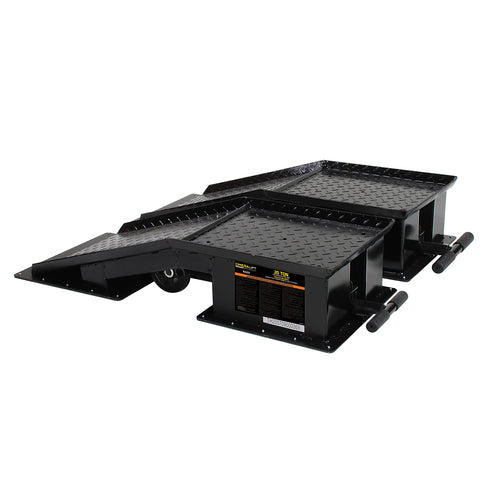
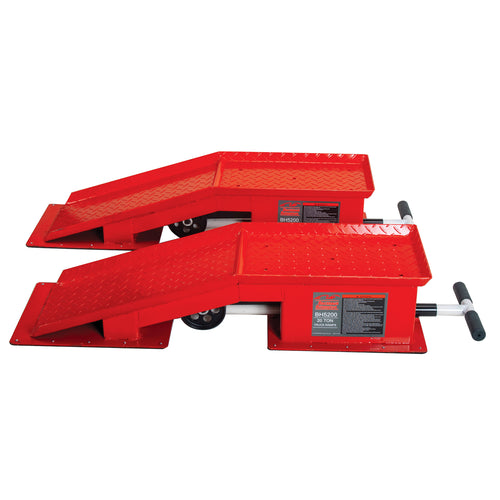
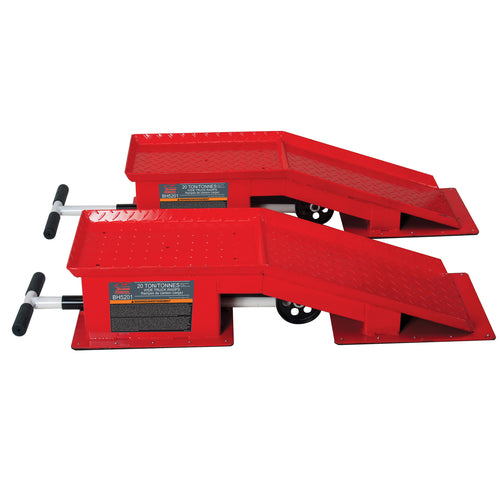
We carry four 20 ton truck ramps from Blackhawk and OmegaLift, in a standard width and a wide version of each. Browse them on our truck ramps page, or read on for how to choose between them.
What are truck ramps used for?
A truck ramp is a drive on platform. You drive the vehicle up the incline until the tires sit on top, which lifts that end of the truck and gives you room underneath. The listings for these ramps give the common jobs:
- Raising a truck for oil changes and underbody inspection
- Driving a vehicle up for quick under chassis access
- Lifting one end of a vehicle for exhaust work
- Raising heavy pickups and trucks without a vehicle lift
- Providing clearance for fluid changes in fleet yards
Typical buyers are fleet maintenance crews, farm and ranch operators, small repair shops and truck owners who service vehicles without a lift.
Truck ramps vs car ramps
Car ramps are sized for passenger vehicles. Truck ramps are built for heavier vehicles and wider, taller tires, which is why you see ratings quoted in tons rather than a few thousand pounds. If you service pickups, vans, trailers or fleet trucks, start with a truck ramp rating. If you only service passenger cars, a lighter ramp may be enough, but ratings still need to be compared with real axle weights.
Truck ramps vs jack stands vs a lift
- Ramps are the quickest way to raise one end for fluid and inspection work. You drive on and drive off, and there is no jacking.
- Jack stands are needed when a wheel has to come off or the axle needs to hang. See our jack stand buying guide and the heavy duty jack stands page.
- A lift gives full access and standing room. Our car lift range covers two post, four post and scissor styles.
How to choose truck ramps
- Capacity. Compare the 20 ton rating with the axle weight of your heaviest vehicle. Check the manual for whether the rating applies to each ramp or to the pair.
- Width. A wider ramp gives more room for wide tires. The wide models below are the ones to look at for wide truck tires.
- Size and weight. These are heavy steel ramps. The listings show item and carton sizes and weights, so plan how you will store and move them.
- Surface. Use them on firm, level ground. Soft or sloped ground is where a ramp can shift.
The 20 ton truck ramps we carry
| Model | Width | Rated capacity | Item dimensions | Item weight |
|---|---|---|---|---|
| OmegaLift 93200 Truck Ramps | Standard | 20 tons | 49.21 x 13.50 x 9.29 in | 252 lb |
| OmegaLift 93201 Wide Truck Ramps | Wide | 20 tons | 49.21 x 18.23 x 9.29 in | 322 lb |
| Blackhawk BH5200 Truck Ramps | Standard | 20 tons | See listing | 267 lb shipping weight |
| Blackhawk BH5201 Wide Truck Ramps | Wide | 20 tons | See listing | 334 lb shipping weight |
The standard and wide versions of each brand share the same 20 ton rating, so the choice comes down to tire width.
How to use truck ramps safely
- Set the ramps on firm, level ground, square to the tires and in a pair.
- Drive up slowly in a straight line, with a spotter if you can.
- Stop with the tires seated on the top of the ramps.
- Set the parking brake and chock the wheels that stay on the ground.
- Inspect the ramps before each use and follow the owner's manual.
Ramps hold the vehicle on its tires. If the work needs a wheel off or the suspension unloaded, switch to rated jack stands rather than improvising.
Related equipment for truck and fleet service
Fleet bays that use ramps often also use an air hydraulic axle jack for wheel work, a wheel dolly to move heavy wheels, and a waste oil drain for fluid changes. Our car dolly and wheel dolly guide covers the dolly side.
Frequently Asked Questions
What are truck ramps used for?
Truck ramps raise one end of a heavy vehicle so you can reach the underside for oil changes, fluid service, exhaust work and inspection without using a lift.
How much weight can 20 ton truck ramps hold?
Each of these models is rated at 20 tons. Check the owner's manual for whether the rating applies to each ramp or to the pair, and compare it with your vehicle's axle weight.
What is the difference between standard and wide truck ramps?
Wide ramps have a broader driving surface for wide tires. The OmegaLift 93201 lists an item width of 18.23 in against 13.50 in for the 93200, and the Blackhawk BH5201 is the wide version of the BH5200.
Are truck ramps safer than jack stands?
They do different jobs. Ramps hold the vehicle on its tires and suit quick fluid and inspection work. Jack stands support the vehicle when a wheel has to come off. Always follow the maker's instructions and chock the wheels that stay on the ground.
Can I use truck ramps on gravel or grass?
Use them on firm, level ground. Soft, loose or sloped surfaces can let a ramp shift, so a hard level pad is the safer choice.
Do I need two ramps?
Ramps are used in pairs, one under each tire on the end you are raising. Check each product page for exactly what is included before you order.
Related guide: working under a raised vehicle on a lift? See our under hoist stand guide.