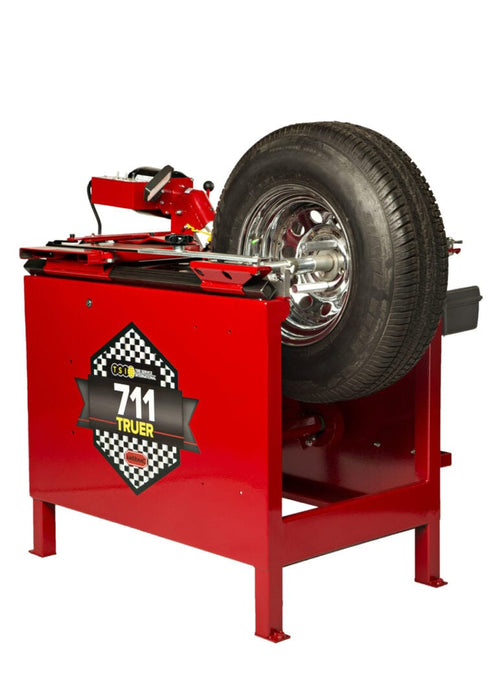
Tire Truing Machine Guide: What Tire Truing Does and How to Choose a Truer
What tire truing is, how a tire truing machine shaves a tire round, when to true versus balance, and how to choose between on car and off car truers for fleet, street and race tires.

Key takeaways
- A tire truing machine shaves a thin layer of tread so the tire runs round on the wheel.
- Truing fixes out of round tires. Balancing fixes uneven weight. Many shops do both.
- Off car truers such as the Amermac 711 and 1200R hold the wheel on an adapter; on car truers such as the 405W Porta Truer roll up to the vehicle.
- Racers shave tires to reduce tread squirm and heat, and some truers allow camber cuts.
- Check tire width, wheel size, adapters and power supply before choosing a truer.
A tire that is out of round causes vibration that no amount of wheel weight will fully fix. A tire truing machine solves that problem by shaving a thin layer of rubber from the tread until the tire runs round on its wheel. This guide explains what tire truing does, how it differs from balancing, which type of truer fits your shop, and what to check before you buy.
What is tire truing?
Tire truing is the process of removing small amounts of tread rubber from the high spots of a tire so the tread is concentric with the wheel. The tire turns on the machine while a powered cutting blade moves across the tread, and a profile follower guides the blade so the cut matches the shape of the tread.
Truing is used in three main ways:
- Correcting out of round tires. New or used tires can have high spots that cause a vibration or hop at speed. Truing removes the high spots.
- Fleet and commercial tires. Bus, truck and trailer tires can be trued to smooth the ride and even out wear.
- Racing and performance. Racers shave tires to a shallower tread depth to reduce tread block squirm, weight and heat buildup, and some truers allow camber cuts.
Tire truing vs wheel balancing
Truing and balancing solve different problems, and many shops use both on the same tire.
| Tire truing | Wheel balancing | |
|---|---|---|
| What it fixes | Out of round tread, high spots | Uneven weight around the wheel |
| How | Shaves rubber from the tread | Adds weights to the rim |
| Typical symptom | Hop or vibration that weights do not cure | Shake or shimmy at speed |
| Equipment | Tire truer, often with a tire warmer | Wheel balancer or on car strobe balancer |
A common order is to warm the tire, true it, then balance the assembly. For more on balancing, see our guides on how to balance a tire and static vs dynamic wheel balancing.
Types of tire truing machines
Off car tire truers
Off car truers hold the tire and wheel on an adapter at the machine. They suit shops that true many tires and want consistent, repeatable cuts. The Amermac 711 tire truer trues bus, truck, trailer, passenger car and light truck tires off the vehicle in as little as 5 minutes with one skilled operator, and comes with the TSI #6400 adapter set, a profile follower, centering gauge and blade guard. The Amermac 1200R tire truer works on all tire applications, produces a flat cut surface with adjustable camber cuts up to 5 degrees, includes the A1 to A6 adapter set and handles tires up to 18 inches wide on wheels up to 24.5 inches. A 6365 wheel lifting ramp helps load wheels onto both machines.
On car tire truers
On car truers roll up to the vehicle and true the tire while it is still on the car, so the whole rotating assembly runs true together. The 405W Porta Truer cuts up to 17.5 inches wide on a 24 inch profile, has a built in profile follower, work light and rotary stone blade sharpener, and runs on 110 to 115V single phase. The 6418 Porta Truer stand lets you also use it with a tire mounted on a spin balancer.
Supporting equipment
- Amermac 975 tire warmer: spins tires for about 4 to 6 minutes to warm them through friction and remove flat spots before truing or shaving.
- 525 low profile spinner: a 7.5 HP on car wheel spinner that rolls under low body cars and trucks.
- Amermac 501A strobe balancer: balances the tire and wheel directly on the vehicle so the hub and rotor or drum are balanced too, and pairs with the 525 spinner.
How to choose a tire truing machine
- List the tires you will true. Passenger, light truck, bus, truck, trailer or race tires, and the largest width and wheel diameter.
- Pick on car or off car. Off car suits volume and consistency. On car suits truing the full rotating assembly and shops with limited floor space.
- Check adapters. Make sure the included adapters fit the lug patterns you see, and price any extra adapter plates.
- Decide on camber cuts. If you shave race tires, look for a truer that allows camber adjustment.
- Confirm power. Check voltage and phase for the truer and any spinner or warmer.
- Plan the workflow. Add a tire warmer, lifting ramp or stand if your work calls for them.
Tips for good truing results
- Warm tires that have sat in a rack or on a parked vehicle so flat spots relax before cutting.
- Take light passes and check runout between passes instead of one heavy cut.
- Keep the blade sharp with the sharpening system and replace worn blades.
- Collect rubber shavings and wear eye and hearing protection.
- Balance the assembly after truing for the smoothest ride.
Browse all wheel balancing and truing equipment or the full Tire Service International range. Questions about which truer fits your tires? Call 888 896 7898 or email support@forgelinesupplyco.com.